For more than two decades, the Amusement Trades Exhibition International (ATEI) was the fixed point around which the British coin-op calendar revolved. Held each January in London, it drew manufacturers, operators, distributors and press from across the UK and beyond — a concentrated few days of deal-making, product launches and industry debate that had no domestic equivalent. When it ended in 2009, it left a gap that the industry is still, in some ways, filling.
What Was ATEI?
ATEI — the Amusement Trades Exhibition International — was the UK’s principal trade show for the coin-operated amusement and gaming sector. It catered to the full supply chain: arcade game manufacturers, amusement with prizes (AWP) machine makers, crane and redemption suppliers, operators running seaside arcades and high-street venues, and the distributors, finance houses and ancillary suppliers that supported them. The show was industry-only; no consumer admission. Its purpose was trade, and that focus gave it a directness that broader entertainment expos rarely matched.
ATEI was organised under the umbrella of BACTA — the British Amusement Catering Trades Association, the sector’s principal trade body, founded in 1974. BACTA created the commercial arm, ATE Group, to manage and grow the show alongside associated business ventures. For most of its life, ATEI was the ATE Group’s flagship property, and its January slot in the London calendar was genuinely non-negotiable for anyone doing serious business in the sector.
Origins: Olympia, 1986
The first ATEI took place in January 1986 at Olympia, London — then, as now, one of the capital’s busiest exhibition venues. The timing was deliberate: January gave operators a clear view of new product ahead of the summer season, and it gave manufacturers a deadline to finalise their lines. That seasonal logic never really changed across the show’s entire run.
The early editions at Olympia were modest by later standards, but they established the format: a dedicated exhibition floor for hardware, a programme of association business running alongside, and an attendance that skewed heavily toward UK trade. International participation grew steadily through the late 1980s and into the 1990s as the show’s reputation spread — particularly among Japanese and American manufacturers seeking a structured European entry point. For companies like Sega, Namco and Konami, ATEI offered direct access to the British and wider European coin-op buying community in a way that no other show could replicate.
Throughout this period, AWPs (amusement with prizes machines) and video arcade cabinets were the dominant product categories. Fruit machines in particular drove significant floor traffic; the UK AWP market was, and remains, one of the most active in Europe, operating under a distinct domestic regulatory framework that made the British trade show circuit essential for any manufacturer targeting that segment.
The Move to Earls Court: 1992 and the Show’s Peak Years
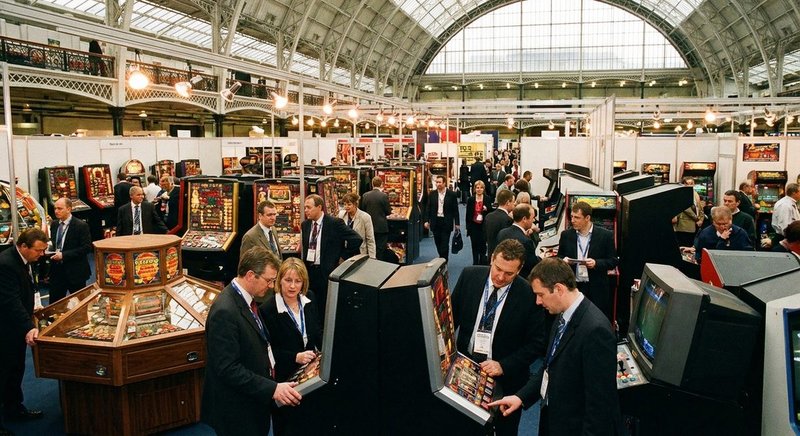
By 1992, ATEI had outgrown Olympia. The show relocated to Earls Court — specifically Earls Court 2, the newer of the two halls on the Warwick Road site — where it would remain for the rest of its run. The move marked a shift in ambition as much as logistics. Earls Court gave ATEI space to grow, and grow it did.
Through the 1990s, the exhibition expanded in both floor space and international reach. SWPs (skill with prizes machines), redemption systems and video game cabinets from the major Japanese publishers joined the traditional AWP contingent. The show became genuinely international in character, though its core audience remained the UK trade.
The mid-2000s represented the high-water mark in raw attendance terms. ATEI 2004, held over three days at the end of January, recorded 294 exhibitors and 13,040 visitors from 119 countries — a record at the time, representing a 5.6% increase on the previous year. That edition illustrated both the breadth of the show’s reach and the underlying health of the sector in the pre-recession period.
The show typically ran Tuesday to Thursday in the last week of January, a schedule that became so embedded in the industry’s rhythm that suppliers planned product launches and operators planned buying trips around it months in advance.
The ATE Group: ATEI Within a Wider Commercial Structure
ATEI did not exist in isolation. BACTA had structured its commercial activities through ATE Group, which by the early 2000s comprised several distinct but related businesses:
- ATEI — the amusements trade show, held annually in January at Earls Court.
- ICE (International Casino Exhibition) — the casino and gaming industry exhibition, co-located at Earls Court and targeting a different but adjacent audience.
- Coinslot International — the UK amusement trade’s weekly newspaper, acquired by ATE in November 2000 from its previous owners, World’s Fair. Coinslot had been the sector’s principal trade publication since the 1970s.
- MachineGuard — a crime intelligence service providing the UK gaming and amusement industry with data on machine theft and related offences.
The bundling of publishing and exhibition assets under one roof gave ATE Group a degree of cross-sector influence that few trade organisations could match. Coinslot, in particular, provided editorial reach that reinforced ATEI’s position as the industry’s annual reference point. Running both the trade press and the trade show created a coherent communications platform for the sector in an era before digital channels existed to serve that function.
The Sale to Clarion Events, 2005
In December 2004, BACTA’s National Council agreed in principle to sell ATE Group. The stated rationale was straightforward: the proceeds would provide long-term funding security for BACTA’s core association activities, separating the trade body function from the commercial exhibition business.
The sale completed in 2005. The buyer was Clarion Events, a London-based exhibitions organiser then undergoing its own period of expansion. According to industry sources, the transaction was valued at approximately £13.5 million, though the precise terms were not publicly disclosed in full.
The acquisition transferred operational control of ATEI, ICE, Coinslot International and MachineGuard to Clarion. BACTA retained its role as the trade association for the sector, but the commercial apparatus that had underpinned the show’s growth was now in private hands. Clarion rebranded the operating entity as Clarion ATE and continued running ATEI at Earls Court, confirming the venue arrangement publicly in 2007 when speculation about Earls Court’s future had begun to unsettle some exhibitors. Clarion ATE’s chief executive at the time, Peter Rusbridge, issued a direct statement welcoming the venue operator’s commitment to honouring existing tenancy arrangements.
The Final Years and the End of ATEI
The post-2005 years were not without tension. The broader coin-op market was shifting: the arcade sector was contracting in the UK as home gaming absorbed leisure spending, and the AWP estate on the high street faced regulatory and economic headwinds. Attendance at trade shows across many sectors softened in the lead-up to the 2008 financial crisis, and ATEI was not immune.
ATEI 2009 was the last edition of the show under that name. After 23 years and an unbroken annual run from 1986, Clarion Events made the decision to rebrand and relocate. The reasoning, as communicated to the trade, centred on the need to modernise the show’s positioning and its physical environment.
Earls Court itself was an ageing venue by this point. While it retained a certain industry familiarity — many operators and exhibitors had attended ATEI there for fifteen or more years — the facilities could not match newer purpose-built exhibition centres. The building would ultimately be demolished in 2015 after the redevelopment of the Earls Court site was approved.
The Transition: EAG Expo Takes Over in 2010
From January 2010, the show relaunched as EAG Expo — Entertainments, Amusements and Gaming — and moved to ExCeL London, the purpose-built exhibition centre in the Royal Docks. The rebrand was intended to reflect a broader market scope, explicitly encompassing the street gaming and AWP sectors alongside traditional coin-op amusements.
The transition was not entirely smooth. January 2010 saw a brief period of industry confusion, with some major exhibitors — including Sega, Namco and Electrocoin — committing to EAG Expo at ExCeL rather than a parallel event that had attempted to continue the ATEI name at Earls Court. The market largely consolidated around EAG Expo within that first year.
EAG Expo has since run annually at ExCeL, with the exception of 2021 (Covid-19). It is now organised by Clarion Gaming, following internal restructuring within the Clarion group, and continues to serve as the UK’s primary coin-op and amusements trade event. For those who attended ATEI across its run, the DNA is recognisable — the January timing, the trade-only format, the mix of hardware manufacturers and operators — even if the name on the door has changed.
Coverage of the current show and upcoming dates is available in our EAG Expo 2027 preview. For the latest industry news and operator updates, visit the ATE Online news section.
ATEI’s Legacy in the UK Coin-Op Sector
It is easy to underestimate what a functioning annual trade show does for a sector. ATEI was not merely a place to see new machines. It was where supplier relationships were cemented over three days on the floor, where regulatory changes were debated in the margins, where a distributor could walk the entire market in a single morning. For smaller operators outside London — running a handful of sites in a regional town — it was often the one event of the year where they engaged directly with the manufacturers whose machines they staked their business on.
The show’s 23-year run from 1986 to 2009 coincided with some of the most significant changes in British leisure: the growth and subsequent decline of the high-street video arcade, the proliferation of AWP machines in pubs and clubs, the early stages of online gaming’s emergence as a competitive force, and the post-millennium shift toward redemption and family entertainment centres (FECs). ATEI was the backdrop to all of it — an annual constant while the market around it changed shape.
Coinslot International, which remains in publication, still carries institutional memory of the ATEI era. Industry figures who attended the show across its run consistently cite it as a formative part of their professional experience — a measure of what a well-run, tightly focused trade event can mean to a specialised sector that lacks the scale to attract mainstream business press attention.
The name ATEI is now largely historical, but the market it served continues. EAG Expo carries forward the essential function, and the coin-op industry’s habit of gathering in London each January — a habit formed across more than three decades — shows no sign of breaking.
The gaming and amusements sector encompasses a wide range of entertainment formats. For operators and visitors interested in the broader gaming landscape — including online casino products that complement the land-based amusements trade — our partners provide comprehensive reviews and operator comparisons in regulated markets.