
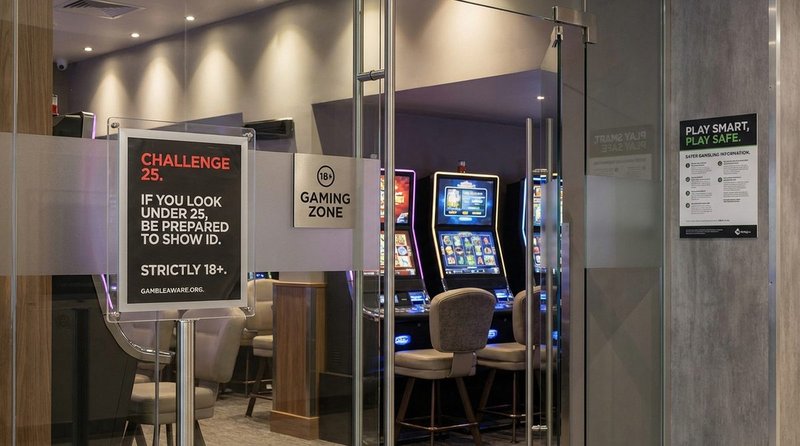
Age verification sits at the heart of responsible gambling compliance for every AGC and licensed FEC in Great Britain. Operators who fail to meet the Gambling Commission’s Licence Conditions and Codes of Practice face licence review, financial penalties, and reputational damage that can be difficult to recover from. This guide sets out what the rules require, who they apply to, and what practical compliance looks like on the floor.
The Legal Framework: UKGC LCCP and the Age Restriction Obligation
The Gambling Act 2005 prohibits under-18s from using Category B and C gaming machines, and the UKGC’s LCCP translates that prohibition into specific, enforceable operator obligations. All holders of an Adult Gaming Centre licence or a Family Entertainment Centre licence authorising Category C machines must maintain a written age verification policy as a condition of their licence.
The Social Responsibility Code — Part 3 of the LCCP — is not advisory. It carries the same legal weight as the Licence Conditions. Under SR Code provision 3.2.1, operators must have documented procedures for preventing underage gambling, must train staff to apply those procedures, and must record that training. The UKGC publishes its UK gaming machine categories framework separately, but for day-to-day compliance purposes it is the LCCP that governs how operators behave on-site.
The written age verification policy must cover: how the Challenge 25 scheme is applied; how staff identify those who may be underage; what documentation is accepted as proof of age; how incidents of attempted underage access are recorded; and how the policy is communicated to all staff before they work unsupervised on the gaming floor.
Challenge 25: How It Works in Practice
Under Challenge 25, any customer who appears to be under 25 must be asked to prove they are 18 or over before accessing Category B3 or C machines. The threshold sits seven years above the legal minimum — this is deliberate, providing a meaningful buffer against staff misjudging borderline cases.
Acceptable proof of age includes a valid passport, photo-card driving licence, or a PASS-accredited proof-of-age card carrying the hologram. Staff are not required to accept any other documentation, and operators should specify in their written policy exactly which forms they will accept. A credit card without a photograph is not sufficient.
BACTA — the trade association representing AGC and FEC operators — publishes Challenge 25 guidance for member venues, which aligns with UKGC requirements and provides practical floor-level protocols. Operators using BACTA UK resources as the basis for their policies benefit from guidance developed in direct dialogue with the Gambling Commission, though the operator remains solely responsible for compliance.
The key operational requirement is consistency. Staff must apply Challenge 25 to every customer who appears under 25, not selectively. Inconsistent application — even if well-intentioned — undermines the policy and will be viewed critically by UKGC inspectors conducting test purchase exercises.
18+ Zone Requirements for Mixed-Use Premises
Any premises that holds both Category C or B3 machines and Category D machines — that is, a licensed FEC rather than a pure AGC — must physically separate the adult-only gaming area from the area accessible to under-18s. This segregation is not discretionary; it is a UKGC licence condition.
The 18+ zone must be clearly delineated so that a customer entering the premises can immediately identify which areas are restricted. The physical separation requirement means that access to the adult gaming area cannot rely on staff observation alone — there must be a structural or physical barrier that prevents casual drift between the Category D floor and the Category C or B3 machines.
In practice, operators achieve this through partitioned sections with a single entry point, dedicated rooms with doors, or turnstile-controlled entry. The specific solution is not prescribed by the LCCP, but whatever arrangement is in place must demonstrably prevent a child from accessing adult machines without being challenged. Operators building new premises or reconfiguring layouts should obtain written confirmation from their compliance adviser that the arrangement satisfies LCCP requirements before going live.
Category D machines — penny falls, cranes, low-value coin pushers — do not require age restriction. Under-18s may use them. The obligation is to ensure the 18+ area is genuinely inaccessible, not to restrict the entire premises.
Signage and Physical Segregation Standards
UKGC-approved safer gambling signage must be displayed at every entry point to an 18+ area. The signage requirement is specific: generic age-restriction notices are not sufficient if they do not meet the Commission’s content and format standards.
The required signage includes: a clear statement that entry is restricted to those aged 18 and over; the GamCare helpline number (0808 8020 133); and the BeGambleAware branding or equivalent approved safer gambling messaging. Operators should check the current UKGC safer gambling messaging guidance before ordering signage, as the approved formats are updated periodically.
Signage must be positioned at eye level at entry points, not buried on a side wall or obscured by promotional materials. During UKGC compliance visits, inspectors check whether signage is visible, current, and positioned where it will actually be seen by someone approaching the 18+ area.
Physical segregation standards require that the barrier — whether partition, door, or turnstile — prevents access without active engagement with the entry point. A rope barrier or a floor marking does not satisfy the requirement. The test applied by the Commission is whether a child could access adult machines without a staff member having an opportunity to challenge them.
Staff Training Obligations
All staff working at an AGC or licensed FEC must receive mandatory age verification training before working unsupervised, and that training must be refreshed at regular intervals. The LCCP does not specify an exact refresher frequency, but the UKGC’s position — reflected in enforcement decisions — is that annual refresher training is the minimum expectation.
Training must cover: the legal age restriction on Category B and C machines; how to apply Challenge 25 correctly; what documentation to accept; how to refuse service without escalating confrontation; and how to record refusals and incidents. Staff who deal with customers on AWP machines and other restricted categories need to understand both the category rules and their personal obligations under the operator’s written policy.
Training records must be maintained and available for inspection. The record should show the date of training, the content covered, the name of the trainer, and the name of the staff member trained. Electronic records are acceptable; a signature-based paper log is equally valid. What is not acceptable is an absence of records — this is one of the most common compliance failures identified during UKGC inspections.
Operators should also ensure that staff understand the BACTA self-exclusion scheme and their obligations when a self-excluded individual attempts to enter the premises. Self-exclusion and age verification are separate obligations, but the staff training programme should address both.
Unlicensed FECs: A Different Regulatory Position
Premises operating exclusively with Category D machines — traditional seaside arcades and small amusement centres with no cash-prize adult machines — do not require a Gambling Commission licence and face a different, lighter set of obligations. However, lighter does not mean absent.
The Gambling Act 2005 still restricts access to certain Category D machines for under-16s. Specifically, machines that pay out in cash (as opposed to non-monetary prizes) are restricted to those aged 16 and over in unlicensed FECs. Operators of unlicensed premises must be clear about which machines in their estate fall into which sub-category of Category D.
Unlicensed FECs do not require an 18+ zone, because they hold no Category C or B3 machines. They are not required to display UKGC safer gambling signage. But they remain subject to the general provisions of the Gambling Act, and they should maintain a basic written policy on age-restricted machines to demonstrate awareness of their obligations — particularly if they operate any machines with a cash-prize element.
Operators who subsequently install a Category C machine — even a single AWP — immediately become subject to the full LCCP regime. This transition catches some operators off guard. The obligation to obtain a Gambling Commission licence, establish an 18+ zone, implement Challenge 25, and train staff does not allow for a grace period once a restricted machine is on the premises.
Consequences of Non-Compliance
The UKGC takes age verification failures seriously, and its published enforcement record makes clear that financial penalties and licence reviews follow from documented non-compliance. Operators should treat age verification not as an administrative exercise but as a core operational function.
The Commission’s enforcement toolkit includes: compliance assessments (announced and unannounced); test purchase exercises using young-looking adults to test Challenge 25 application; review of training records and written policies; and formal investigations triggered by complaints or referrals from local authorities.
Where a compliance failure is identified, the Commission may issue a warning, impose a financial penalty, attach additional conditions to the licence, or — in serious or repeated cases — suspend or revoke the licence. Financial penalties are calculated against the operator’s annual Gross Gambling Yield; they are not capped at nominal sums. In recent years the Commission has imposed six-figure penalties on land-based operators for systemic social responsibility failures, including age verification breakdowns.
Local authorities also retain enforcement powers under the Gambling Act, including the power to object to licence renewals. An operator with a documented age verification failure will find that history raised during any subsequent licensing hearing.
Operators who discover a compliance gap — whether through internal audit, a failed test purchase, or a staff error — should document the failure, take immediate corrective action, and consider whether a proactive disclosure to the Gambling Commission is appropriate. Proactive engagement is consistently treated more favourably in enforcement decisions than failures discovered by the regulator.
Frequently Asked Questions
Does Challenge 25 apply to Category D machines?
No. Challenge 25 is required for Category B3 and C machines in licensed premises. Category D machines in an unlicensed FEC do not require Challenge 25, though operators must still restrict cash-prize Category D machines to those aged 16 and over. In a licensed FEC where Category D machines are located outside the 18+ zone, staff are not required to apply Challenge 25 to customers using those machines.
What physical barrier is required for an 18+ zone?
The LCCP does not prescribe a specific type of barrier, but the standard applied by the UKGC is that the barrier must prevent a child from accessing adult machines without being actively challenged. A rope or floor marking does not meet this standard. Operators typically use partitions with a staffed or controlled entry point, a door, or a turnstile. The chosen solution must demonstrably work in the context of that specific premises.
How often must age verification training be refreshed?
The LCCP requires regular refresher training but does not specify a fixed interval. The UKGC’s enforcement position treats annual refresher training as the minimum acceptable standard. Records of all training — initial and refresher — must be maintained and available for inspection.
Can an unlicensed FEC install a Category C machine without a Gambling Commission licence?
No. Any premises operating a Category C machine must hold a Gambling Commission Adult Gaming Centre or Family Entertainment Centre licence. Installing a Category C machine without the appropriate licence is a criminal offence under the Gambling Act 2005. The licence, 18+ zone, written policy, Challenge 25 procedures, and staff training must all be in place before the machine is made available for play.
The age verification standards that apply across the AGC and FEC sector reflect the same principles embedded throughout Britain’s licensed gaming framework — that access to gambling products must be controlled, documented, and enforced consistently. Those same principles underpin the regulatory requirements for online casino operators licensed by the UKGC, where age and identity verification must be completed before a customer can deposit or play. Understanding how verification obligations operate across the land-based sector provides useful context for operators and suppliers working across both environments.