
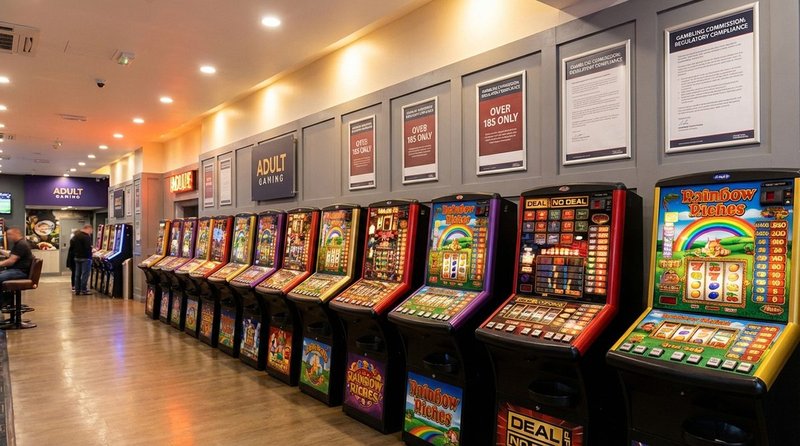
Every Amusement With Prizes (AWP) machine placed in a UK venue exists within a regulatory framework administered primarily by the UK Gambling Commission (UKGC). From the Technical Standards Certificate a machine must carry before it reaches a premises floor, to the social responsibility conditions that bind operating licence holders, the Commission’s reach into the amusements sector is extensive. This guide sets out the obligations that matter — what they require, where they apply, and where the rules diverge by venue type.
Understanding the UKGC’s framework is not purely a legal exercise. Compliance failures in this sector attract financial penalties, licence suspensions, and in serious cases revocation. The Commission has sharpened its enforcement posture in recent years, and operators who treat regulatory requirements as a back-office concern are increasingly exposed.
The UKGC’s Role in AWP Regulation
The UK Gambling Commission is the statutory regulator for commercial gambling in Great Britain. Its authority derives from the Gambling Act 2005, which established the Commission as the body responsible for issuing operating licences, setting technical standards, and enforcing compliance across the sector. Northern Ireland is outside the Commission’s jurisdiction — gambling regulation there is governed by separate legislation under the Betting, Gaming, Lotteries and Amusements (Northern Ireland) Order 1985.
The UKGC’s remit covers operators, manufacturers, and software suppliers across both land-based and remote gambling. For the amusements sector, its primary functions are:
- Issuing and revoking operating licences for Adult Gaming Centre (AGC) and Family Entertainment Centre (FEC) operators who offer Category C or higher machines.
- Publishing and enforcing UK gaming machine categories — the technical standards that all gaming machines must meet before lawful placement.
- Setting the Licence Conditions and Codes of Practice (LCCP) that govern how licence holders run their operations.
- Conducting compliance assessments and enforcement action against non-compliant operators and premises.
The Commission does not issue premises licences — that function sits with local licensing authorities, operating under parameters the UKGC sets. This division between operating licence (UKGC) and premises licence (local authority) is a practical distinction that operators must track across their estate.
Technical Standards Certificates: What Operators Need to Know
No AWP machine may lawfully be made available for play in Great Britain unless it holds a Technical Standards Certificate (TSC) issued by a UKGC-approved test house. This is a pre-market requirement: the machine must pass testing before it reaches the premises floor, not after.
The UKGC’s gaming machine technical standards cover the following areas:
- Random Number Generator (RNG) integrity: The RNG must produce genuinely random, statistically unbiased outcomes. Test houses verify the RNG algorithm, seeding, and implementation across hardware and software.
- Payout percentages: The machine must be capable of returning the stated theoretical payout percentage. Standards set parameters around how this is configured and displayed.
- Display requirements: Machines must display specified information to players — including stake amounts, prize values, and safer gambling messages — in a clear and accurate format.
- Player protection features: Requirements include session time and spend display, and on certain categories, facilities for players to set limits or receive prompts.
- Software integrity: The software build tested must match the build deployed. Any material software modification requires re-testing and re-certification.
For operators, the practical implication is straightforward: only purchase or lease machines from suppliers whose products carry valid TSCs for the relevant category and configuration. Placing an uncertified machine — even inadvertently — is a compliance breach. Operators should request confirmation of TSC status from their equipment suppliers as part of standard procurement due diligence.
In January 2025, the UKGC opened a consultation proposing to consolidate the existing 12 separate gaming machine technical standards into a single unified standard, and to introduce five new standards covering time and monetary limit-setting functionality and safer gambling information provision. The consultation closed in May 2025. Operators should monitor the UKGC’s published response for implementation timelines, as new standards will affect machine specifications across categories B and D.
UKGC-Approved Test Houses
Technical Standards Certificates are issued only by test houses formally approved by the Gambling Commission. As of 2025, the approved test houses for gaming machine certification include Gaming Laboratories International (GLI), BMM Testlabs, iTech Labs, and NMi Gaming. The Commission maintains a current public register of approved test houses on its website — operators should verify approval status directly against this register rather than relying on supplier assurances alone.
| Test House | Abbreviated Name | Notes |
|---|---|---|
| Gaming Laboratories International | GLI | UKGC-approved since 2008; incorporates TST (Technical Systems Testing) |
| BMM Testlabs | BMM | Internationally active; approved for UK gaming machine testing |
| iTech Labs | iTech | UKGC-approved; active across RNG and gaming machine certification |
| NMi Gaming | NMi | Netherlands-headquartered; UK and EU regulatory approvals |
Source: Gambling Commission approved test houses register. Operators should verify current status at gamblingcommission.gov.uk.
The test house issues the TSC upon successful testing. The certificate is specific to the machine model, software version, and configuration tested. If an operator modifies a machine’s software or hardware in a way that affects its gambling function, a fresh certification may be required. Suppliers typically handle re-certification as part of software update processes, but operators should confirm this contractually.
Licence Conditions and Codes of Practice (LCCP)
The LCCP is the primary rulebook for UKGC operating licence holders. It divides into two distinct categories of obligation — and the distinction matters operationally.
Licence Conditions are mandatory. Breach of a licence condition is grounds for regulatory action, including financial penalty or licence revocation. These are not guidelines — they are hard requirements that attach to every operating licence the UKGC issues. Licence conditions cover areas including anti-money laundering, customer interaction, staff suitability, and financial resilience.
Codes of Practice operate differently. They divide into two sub-types:
- Ordinary Codes of Practice: Represent the Commission’s recommended approach. Licence holders must have regard to them but are not required to follow them exactly — provided they can demonstrate an equivalent or superior approach to achieving the underlying objective.
- Social Responsibility Codes of Practice (SRCP): These carry the same mandatory force as licence conditions. They set out specific responsible gambling obligations that operators must implement, not merely consider.
The UKGC updates the LCCP periodically. In 2025, amendments included new provisions around customer financial limits (requiring online operators to have customers set a deposit limit before first deposit from 31 October 2025) and enhanced financial vulnerability checks for remote operators. While many of the 2025 LCCP amendments target online operators specifically, land-based operators holding UKGC licences should review updated LCCP editions on publication — some provisions apply across both remote and non-remote licences.
Social Responsibility Obligations
The Social Responsibility Code of Practice sets out the minimum responsible gambling standards that UKGC operating licence holders must meet. For AWP operators holding AGC or licensed FEC operating licences, the relevant requirements include the following.
Responsible Gambling Policies
Licence holders must maintain a written responsible gambling policy, keep it under review, and ensure staff are trained to implement it. The policy must cover how the operator identifies and responds to customers who may be at risk. For land-based amusement venues, this means staff training programmes that cover recognising signs of problem gambling, how to approach customers, and what referral pathways are available.
Self-Exclusion
Operating licence holders must operate a self-exclusion scheme that allows customers to exclude themselves from gambling at their premises for a minimum period of six months. BACTA operates a sector-wide self-exclusion scheme for its members, which AGC and licensed FEC operators can use to fulfil this obligation. Operators must take reasonable steps to prevent self-excluded customers from accessing gaming machines — including staff identification checks and physical access controls where practicable.
Age Verification
Category C machines are restricted to adults (18+). Any premises offering Category C machines must ensure those machines are not accessible to under-18s. In practice, this means physical separation of adult-only machine areas, clear signage, and Challenge 25 age verification procedures. Staff must be trained in age verification, and records of training should be maintained as evidence of compliance.
Category D machines carry no statutory age restriction under current law — children may legally play them. However, operators must still comply with any LCCP provisions around interaction with vulnerable customers, which may encompass young people in certain contexts.
Safer Gambling Information
UKGC licence holders must display approved safer gambling information, including details of GamCare and other support services. The format and positioning of signage is set out in UKGC guidance. Operators should ensure signage is current — the Commission updates approved messaging periodically.
Category D and Unlicensed FECs: A Special Case
The licensing framework creates an important carve-out for operators whose machine estate consists entirely of Category D machines: they do not require a UKGC operating licence. A local authority permit is sufficient.
An unlicensed Family Entertainment Centre (FEC) — a premises offering Category D machines only, with no Category C or higher — may operate under a permit issued by the local licensing authority rather than a UKGC operating licence. This permit is available under the Gambling Act 2005 and is valid for ten years. There is no requirement to hold a UKGC operating licence, and accordingly the full LCCP does not apply to unlicensed FEC permit holders in the way it applies to operating licence holders.
This is a commercially significant distinction. Many seaside arcades, soft-play centres, and family leisure venues operate as unlicensed FECs — confining their machine offer to Category D and thereby keeping their regulatory obligations at local authority level. The trade-off is clear: add a single Category C machine to the floor, and the requirement for a UKGC operating licence is triggered immediately.
The position is different for Category C machines in every other respect:
- Category C always requires a UKGC operating licence. There is no permit pathway for Category C — it is not available to unlicensed FECs, and no local authority permit covers it.
- Pubs and clubs with an alcohol licence may offer up to two Category C or D machines under an automatic entitlement, but any expansion beyond two machines requires a Licensed Premises Gaming Machine Permit from the local authority — and the operator must still hold the relevant operating licence if Category C is among them.
For operators considering expanding from Category D into Category C, the regulatory step-change is significant. A UKGC operating licence application requires a fit-and-proper assessment of key personnel, a demonstration of financial resilience, and acceptance of the full LCCP framework. Operators should build adequate lead time into any commercial planning that involves introducing Category C machines.
UKGC Enforcement: What Triggers an Investigation
The Gambling Commission uses a risk-based compliance approach. Its enforcement toolkit ranges from informal engagement to licence revocation, and the Commission has demonstrated willingness to impose substantial financial penalties where breaches are serious or repeated.
Triggers for compliance assessment and investigation typically include:
- Complaints from the public or local authorities — including complaints about underage access, problem gambling incidents at specific premises, or unlicensed machines.
- Compliance assessments: The UKGC conducts proactive assessments of operating licence holders. These may be desk-based reviews of policy documents and training records, or involve visits to premises.
- Mystery shopper visits: The Commission uses mystery shopper exercises to test compliance with age verification, responsible gambling signage, and other observable requirements. Failures identified through mystery shopper activity have been cited in public enforcement decisions.
- Self-reported compliance failures: Licence holders are required to report certain events to the UKGC — including significant compliance failures — as a condition of their licence. Failure to self-report is itself a breach.
- Intelligence from partner agencies: The Commission shares information with HMRC, local authorities, and police. Machine Games Duty irregularities flagged by HMRC can initiate UKGC scrutiny, even though MGD is HMRC-administered and separate from UKGC licensing.
Financial penalties issued by the UKGC in recent years have ranged from tens of thousands to several million pounds for the largest operators. For smaller amusement operators, the reputational and commercial consequences of a public enforcement action — including named press releases on the UKGC website — can be disproportionately damaging. Prevention is the operationally rational position.
It bears repeating: Machine Games Duty is administered by HMRC, not the UKGC. An MGD non-compliance is a tax matter with HMRC, not a licensing matter with the Commission. However, the two can intersect — and operators who are non-compliant in one area are more likely to receive scrutiny in the other.
The 2025 Category D Consultation
The regulatory landscape for Category D machines is under active review. In October 2025, the Department for Culture, Media and Sport (DCMS) launched a formal consultation on two areas of direct relevance to the amusements sector: the categorisation of Category D gaming machines, and potential changes to stake and prize limits.
Category D stake and prize limits have not been revised since 2014. With inflation eroding the real value of the current £5 maximum cash prize for money-prize AWP machines, the industry has long argued that the limits require updating. The BACTA submission to previous consultations has consistently flagged that static limits reduce the commercial attractiveness of compliant AWP machines relative to other leisure spending.
The DCMS consultation also proposed making it an offence to invite, cause, or permit anyone under 18 to use cash-out slot-style Category D machines — a response to concerns about the design characteristics of certain newer Category D products. This proposal, if enacted, would require operators with affected machine types to review their placement and access arrangements.
The consultation closed on 4 December 2025. As of early 2026, the government’s formal response setting out its conclusions and any legislative or regulatory changes has not yet been published. Operators should monitor DCMS and UKGC publication channels, and BACTA communications, for the response — which is expected to set the parameters for any subsequent secondary legislation amending the Categories of Gaming Machine Regulations.
Frequently Asked Questions
Does an operator need a UKGC licence to place Category D AWP machines?
Not if the premises operates as an unlicensed FEC offering Category D machines only. A local authority permit suffices. A UKGC operating licence is required as soon as Category C or higher machines are added to the premises.
What is a Technical Standards Certificate and who issues it?
A TSC is a certificate confirming that a specific gaming machine model and software build has been tested against the UKGC’s technical standards by an approved test house. Approved test houses as of 2025 include GLI, BMM Testlabs, iTech Labs, and NMi Gaming. Machines must hold a valid TSC before lawful placement for play.
What is the difference between a Licence Condition and a Code of Practice in the LCCP?
Licence Conditions are mandatory requirements — breach is grounds for regulatory action. Ordinary Codes of Practice set best-practice standards that operators must have regard to but can depart from if they achieve the underlying objective another way. Social Responsibility Codes carry the same mandatory force as Licence Conditions.
Does the UKGC regulate Machine Games Duty?
No. MGD is a tax administered by HMRC under its Excise Notice 452 framework — it is entirely separate from UKGC licensing. Operators must register with HMRC for MGD if their machines are not exempt. The UKGC does not set MGD rates or handle MGD compliance.
What were the key proposals in the 2025 UKGC gaming machine technical standards consultation?
The January 2025 consultation proposed consolidating 12 separate technical standards into a single standard, introducing five new standards around player limit-setting and safer gambling information, and allowing players to gamble live jackpot wins across all machine categories. The consultation closed in May 2025; operators should monitor the UKGC’s published response for implementation timelines.
What triggers a UKGC compliance investigation for an amusement operator?
Common triggers include public or local authority complaints, proactive UKGC compliance assessments, mystery shopper visits identifying failures in age verification or responsible gambling signage, self-reported compliance failures, and intelligence from HMRC or other partner agencies.
The UKGC’s operating licence framework governs not only land-based amusement operators but online gambling businesses operating in Great Britain. Remote casino, slots, and gaming operators hold UKGC licences under the same statutory framework and face the same LCCP obligations — with additional online-specific conditions including enhanced financial vulnerability checks and mandatory deposit limit-setting. Operators active in both land-based amusements and online-adjacent channels operate under a single, consistent UKGC licensing structure.