
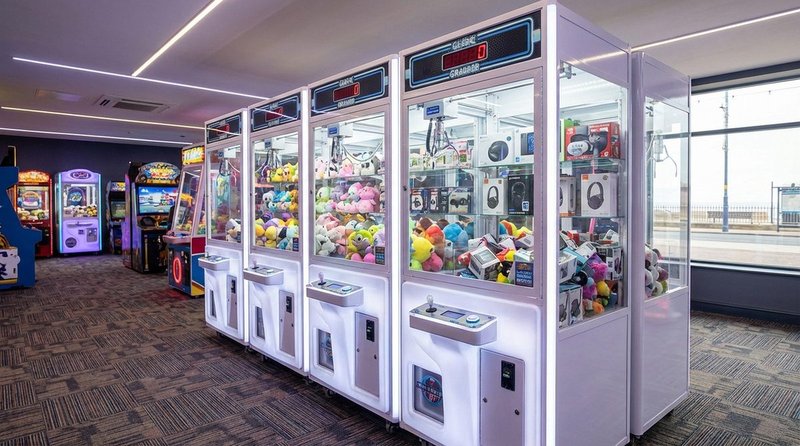
Crane machines are among the most recognisable fixtures in British arcades, FECs and retail amusement zones. Their appeal cuts across age groups, their footprint is modest relative to revenue, and their regulatory position — once understood — is straightforward. Yet operators still encounter confusion about Category D classification, claw strength obligations, and exactly which premises can site them without a gambling licence. This guide addresses all of it, from buying decisions through to weekly prize-fill budgeting.
Crane Machine Mechanics: How the Claw Works
At its core, a crane machine presents the player with a joystick-controlled gantry and a three- or four-prong claw suspended above a prize bed. The player manoeuvres the claw over a target prize and triggers a drop. What happens next determines everything commercially: the claw descends, grips — and either holds or releases.
Modern machines use programmable claw-strength controllers. Operators set a grip force via an internal menu, and that force can be configured to vary across a cycle of plays. A typical configuration runs the claw at reduced grip strength for a defined number of plays — often two out of three — and at full grab strength on the third. The machine thus controls its own prize-pay rate independently of player skill.
Cabinet electronics log total plays, prize deliveries, and cash taken. Most machines in UK distribution support telemetry or USB data export, allowing operators to monitor performance remotely or during collection visits. Understanding the relationship between grip cycle, average play value, and prize cost is the foundation of sustainable crane machine operation.
UK Regulatory Position: Non-Monetary Prize and Category D
Crane machines dispensing non-monetary prizes — stuffed toys, merchandise, confectionery — sit within the UK machine categories framework as a Category D sub-type under the Gambling Act 2005. Because the prize has no monetary value in the hands of the player (it cannot be exchanged for cash at the machine), the machine does not trigger the cash-prize restrictions that apply to AWP machines.
The Gambling Commission’s position is that a machine whose outcome depends entirely on player skill is not a gambling product. Crane machines occupy a more complex position: player input influences the claw’s horizontal position, but the grip outcome is substantially controlled by the programmed strength cycle. The Commission treats them as low-risk amusement machines rather than gambling machines, provided prizes remain non-monetary and stake limits are observed. Category D maximum stake is 10p; maximum non-monetary prize value is £8.
Operators must also satisfy age verification obligations where machine mix on premises creates a requirement — particularly relevant in mixed-category FEC environments. Crane machines themselves carry no minimum age restriction, but premises-level obligations apply.
On Machine Games Duty: crane machines dispensing only non-monetary prizes are not dutiable gaming machines under the MGD rules. Dutiable machines are those where the prize can be money or a token exchangeable for money. Operators should confirm this classification with their tax adviser if the prize configuration includes any voucher or credit component.
Siting Requirements: Where Cranes Can Operate
This is the regulatory advantage crane machines hold over AWP and higher-category products. Under the Gambling Act 2005, Category D machines may be sited in unlicensed family entertainment centres holding the appropriate FEC permit. An unlicensed FEC permit — obtainable from the local authority — is sufficient for Category D-only premises.
In practice, this means a shopping centre amusement zone, a seaside arcade without a gambling licence, or a soft-play facility with coin-op units can all operate crane machines legally without engaging with the Gambling Commission licensing process. The permit route is lower cost and administratively lighter than a full premises licence.
Crane machines may also be sited in licensed FECs, adult gaming centres, and other licensed gambling venues. Physical siting matters commercially as well as legally. High-footfall positions near entrance points or food queues outperform back-wall placements consistently. Crane machines require 240V supply, level flooring (glass-front models are sensitive to tilt-switch trips), and adequate clearance for the service door.
Cabinet Formats: Single-Player, Dual-Player, Bulk Toy Models
The UK market divides broadly into three cabinet formats, each suited to different venue types and floor-space economics.
Single-player standard cranes are the traditional format — one joystick, one claw, a prize bed typically 60–80cm wide. Cabinet footprint runs approximately 90cm × 90cm. These remain the staple of smaller seaside arcades and independent FECs.
Dual-player cranes have gained significant ground in larger FECs over the past five years. Two players compete simultaneously from opposite sides of a shared prize bed. Throughput doubles relative to floor space, and the competitive element generates additional dwell. Elaut’s dual-player range and Bandai Namco’s dual-entry models are the most commonly specified in new UK FEC builds. Cabinet footprint is typically 160cm × 90cm, but the revenue-per-square-metre calculation favours them in high-footfall sites.
Bulk toy or high-capacity cranes dispense smaller, lower-cost prizes from a larger prize bed — often confectionery or small plush items. These suit high-volume, lower-dwell environments such as supermarket foyers or fast-food premises.
For operators sourcing across formats, the broader arcade cabinet types guide covers physical dimensions and power requirements in more detail.
Claw Strength Settings and the Skill vs. Chance Question
Claw strength programming is simultaneously the machine’s most commercially significant feature and the source of its regulatory ambiguity. UK operators configure grip cycles under parameters consistent with The Amusements With Prizes (Permits) Regulations — the machine must present a genuine play experience and not function as a pure deception device.
In practical terms, most UK operators configure a grab cycle where full-strength grip is triggered on one in every two or three plays. On reduced-strength plays, the claw may grip initially but releases the prize before delivery. The cycle is not visible to the player but is accessible to the operator via the service menu.
The Gambling Commission has not issued specific guidance prescribing maximum claw-release ratios for Category D crane machines, but operators should be aware that a machine configured to virtually never deliver risks crossing into territory where the Commission would question whether a genuine skill element exists. Documented operational settings, logged prize-pay rates, and calibration records are good practice for any operator who may face a compliance enquiry.
The practical benchmark most experienced operators apply: aim for a prize delivery on one in every 8–12 plays. At 10p per play, 10 plays generates £1.00. At a 25% prize-cost ratio, prizes averaging £2.50 should deliver approximately once per ten plays.
Prize Filling, Stock Management and Revenue Benchmarks
Well-managed crane machines in high-footfall UK locations — theme parks, large FECs, city-centre arcades — achieve £200–£500 per week in gross income. Pier and seaside sites during summer trade can exceed that range. Budget shopping-centre sites at lower footfall will perform towards £80–£150 per week.
Prize cost as a percentage of turnover should sit between 20–30% for sustainable operation. Below 20%, the prize bed looks thin and player perception suffers. Above 30%, margin erodes quickly. Operators achieving the best results monitor prize-cost ratio per machine monthly rather than annually.
Most UK operators source plush and stuffed toy prizes from specialist amusement prize wholesalers. Elaut operates a prize shop supplying its crane network; Bandai Namco publishes a prize catalogue updated seasonally. The bulk of physical stock originates from manufacturers in Hong Kong and mainland China, imported via specialist amusement trade wholesalers. Operators running multiple machines benefit from holding 4–6 weeks of buffer stock.
Key Manufacturers and UK Distributors
Elaut (Belgium) is the largest European crane machine manufacturer and a dominant presence in UK FEC installations. Their range spans single-player, dual-player, and bulk-prize formats. Elaut operates direct UK service infrastructure and supplies through approved distributors.
Bandai Namco Amusement Europe supplies both crane machines and the licensed IP prize content that fills them — an integrated offer that appeals to FEC operators seeking coherent prize programming alongside hardware.
ICE (Innovative Concepts in Entertainment), a US manufacturer, has a UK distribution presence and is known for feature-rich single-player cranes with high cabinet presence on the floor.
Smart Industries produces a range of crane and prize machine formats sold into the UK market via trade distribution. Electrocoin is among the established UK amusement distributors supplying crane models alongside wider arcade equipment portfolios.
Post-Brexit, new machines sold into the GB market require UKCA marking. Operators and distributors should confirm current compliance requirements with their supplier at point of purchase.
Frequently Asked Questions
Do crane machines require a gambling licence to operate in the UK?
No. Crane machines dispensing non-monetary prizes are classified as Category D machines under the Gambling Act 2005. They can be sited in unlicensed family entertainment centres holding a local authority FEC permit. A Gambling Commission premises licence is not required for Category D-only operations.
What is the maximum stake and prize value for a crane machine?
Under Category D rules, the maximum stake per play is 10p and the maximum non-monetary prize value is £8. These limits are set by the Gambling Act 2005 and associated statutory instruments. Cash prizes are not permitted for Category D crane machines.
How do I set claw strength legally in the UK?
Claw strength is configured via the machine’s internal service menu. There is no specific statutory ratio mandated by the Gambling Commission for Category D crane machines, but the machine must offer a genuine play experience. Most UK operators run a cycle where full-grip strength is applied on one in two or three plays. Keeping calibration logs and prize-pay records is recommended best practice.
What revenue can I expect from a crane machine in a UK arcade?
In high-footfall UK locations — large FECs, theme parks, busy seaside arcades — crane machines typically generate £200–£500 per week gross. Lower-footfall shopping-centre siting produces £80–£150 per week. Prize cost should be managed to 20–30% of turnover. Location quality is the primary performance driver.
The skill-versus-chance debate that shapes crane machine regulation is the same question the UKGC applies when classifying online products: at what point does player input cease to determine outcomes and random or programmed mechanics take over? That line — between a game of skill and a game of chance — sits at the centre of how both land-based amusement machines and digital gaming products are licensed, and it is a boundary the Commission has shown increasing willingness to test through compliance review and formal guidance.