
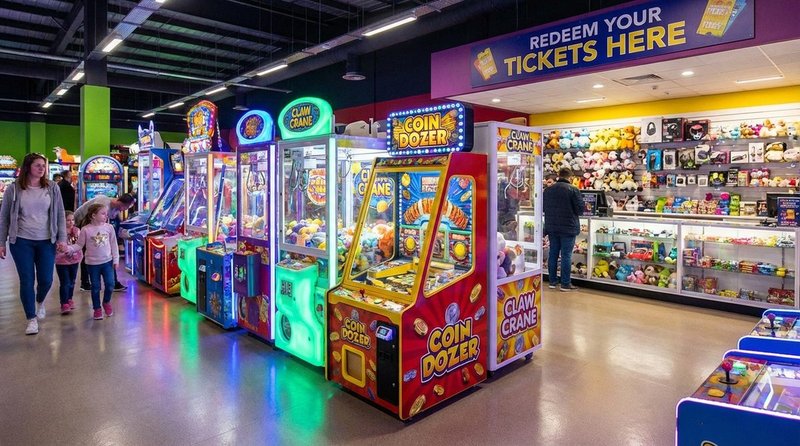
Redemption gaming has become the backbone of the UK family entertainment centre model. Walk into any well-run FEC from Aberdeen to Bournemouth and you will find rows of ticket-dispensing machines drawing queues of children clutching their winnings, parents calculating how many more credits they need to reach the prize counter. For operators, the attraction is straightforward: redemption games deliver strong yields, generate repeat visits and — critically — sit outside the scope of the Gambling Act 2005 when configured correctly. This guide covers everything an equipment buyer or arcade manager needs to know before building or refreshing a redemption floor.
What Are Redemption Games? Tickets, Tokens and Prize Counters
Redemption games are amusement machines on which players earn tickets, tokens or digital credits that they later exchange for prizes at a dedicated prize counter. The key distinction from gambling is mechanical: in a genuine redemption game, the outcome is determined by player skill — accuracy, timing, reaction — rather than chance alone, and the prize value remains below the thresholds set under the Gambling Act 2005.
The classic format uses ticket-out (TTO) dispensers: the machine physically ejects a paper strip of tickets proportional to the player’s score. Players accumulate tickets across multiple plays, hand them to staff at the prize counter, and select merchandise from tiered prize shelves. Low-ticket prizes typically include erasers, keyrings and small plush toys; the aspirational top-shelf items — branded electronics, large plush figures, premium merchandise — require hundreds or thousands of tickets and drive repeat visits.
Card-based systems from suppliers such as Embed and CenterEdge are gaining ground in UK FECs. Instead of physical tickets, credits are loaded to a swipe card. Players tap their card at each machine to log winnings electronically and redeem at the counter. Operators report reduced cleaning costs, eliminated ticket jamming, and faster prize-counter transactions. The investment in card readers and back-office software is offset within twelve to eighteen months at most mid-size sites.
UK Regulatory Position: Redemption vs. Gambling
Redemption machines are legally classified as amusement machines, not gaming machines, provided two conditions are met: outcomes are predominantly skill-based, and prize values do not exceed the relevant Gambling Act thresholds. The Gambling Commission has confirmed in published guidance that genuine skill-based redemption games with low-value prizes do not require a gambling licence.
This matters practically. An FEC operator running only redemption machines, crane machines and video amusements does not need a Gambling Commission operating licence. The moment Category C AWP machines are added to the floor, the legal position changes entirely: an operating licence is required, LCCP obligations apply, and age verification becomes mandatory under statute. Operators running a mixed floor should review the UK machine categories framework carefully before buying or leasing any new equipment.
The practical test for whether a redemption machine crosses into gambling territory is the prize-value ceiling. Machines where no individual prize exceeds a minimal monetary value remain outside the Gambling Act. Operators who offer high-value electronics or cash-equivalent vouchers as redemption prizes are in murkier territory and should seek independent legal advice. The distinction between an FEC permit and a full licence is relevant here: understand which category your site falls into before adding any prize tier above £5 retail value.
Popular Redemption Game Categories
Ticket Hopper and Pusher Games
Coin or token pusher games are a staple of the British seaside tradition. Modern versions have grown considerably more sophisticated, incorporating themed overlays, LED lighting and tiered jackpot mechanics. They are low-skill, high-dwell and particularly effective at younger age groups. Ticket yield per credit tends to be modest; the real value is in transaction volume at busy sites.
Skill-Based Ticket Games
Basketball shooters, skee-ball lanes, air hockey and target-shooting machines form the core of the skill redemption category. These games have the clearest legal standing — the player’s accuracy directly determines ticket output — and tend to attract older children and adults. Bandai Namco Amusements Europe’s Basketball Pro range and Sega Amusements’ catalogue of sports-themed cabinets are among the most consistently placed products in UK FECs. Floor space requirements are moderate; a single skee-ball lane needs roughly 1.8m × 0.7m plus player clearance.
Video Redemption
Video redemption titles combine arcade game mechanics with ticket payout. Titles from Raw Thrills (available through UK distributors) and Bandai Namco — including Pac-Man variants with built-in ticket dispensers — offer high visual impact and strong player engagement. Elaut produces several video redemption products active in the UK market. These machines typically require more floor space than standalone ticket games and carry higher capital cost, but they command premium coin-per-play rates and generate strong yield at well-trafficked sites.
Setting Up a Redemption System: Ticket or Token, Prize Counter, POS
A functioning redemption system requires three components to work in concert: the machines themselves, a prize counter operation, and a point-of-sale or card management system.
Prize counter placement is not cosmetic — it is strategic. The counter should be visible from the FEC entrance and positioned so that players carrying tickets must pass other machines to reach it. Sightlines matter: children seeing peers collect prizes creates social proof and drives further play. Stock your prize counter in three tiers: a low tier accessible on a single-game session (20–50 tickets), a mid tier requiring two or three sessions, and an aspirational top shelf that necessitates multiple visits.
If adopting a card-based system, budget for reader hardware on every machine, a back-office server, and staff training. The upfront cost is significant but the operational saving in ticket management, prize counter speed and reduced machine downtime from ticket jams is material at any site processing more than 500 plays per day.
Revenue and Yield Management: Ticket Cost and Prize Margin
Redemption profitability depends on one ratio: the cost of tickets dispensed versus the retail value of prizes redeemed. A well-managed redemption floor targets a prize redemption rate of 25–35% of gross turnover — meaning for every £100 taken at the machines, £25–35 is spent on prizes (at retail price). Typical ticket cost per credit runs at £0.003–£0.008, depending on machine configuration and ticket reel pricing from the supplier.
Top-performing redemption games in high-footfall UK FECs — theme parks, retail-linked venues, city-centre sites — can generate £400–£800 per week per unit. Coastal arcades and smaller town-centre sites typically land in the £150–£300 range depending on seasonality. New equipment underperforms for six to eight weeks while players learn the machines; factor this into cashflow projections.
Operators should review ticket yield settings quarterly. Machines set too generous on tickets erode margin; machines set too tight produce player frustration and reduced dwell time. Most modern redemption cabinets allow ticket-per-credit ratios to be adjusted via operator menus without specialist engineering.
Key Manufacturers Available in the UK
Bandai Namco Amusements Europe operates a UK division with direct sales and service. Their Basketball Pro series and Pac-Man branded redemption titles are among the most-placed products in UK FECs. Parts availability and engineer response are generally strong.
Sega Amusements International maintains a UK operation covering both sales and technical support. Their video redemption and sports ticket game portfolio suits mid-to-large FEC formats.
Elaut (Belgian manufacturer, strong UK distribution presence) specialises in crane machines and token-operated redemption games. See the dedicated guide on crane machines for Elaut’s claw-machine range specifically.
Raw Thrills titles — including Big Buck Hunter and various sports titles with ticket-out capability — are available through several UK distributors. Buyers should confirm parts lead times with their distributor before purchase, as Raw Thrills’ UK parts support operates through third parties rather than a direct subsidiary.
When evaluating any manufacturer, ask three questions: what is the average time-to-repair on a callout, what is parts availability on a two-year-old cabinet, and does the supplier offer operator training on ticket yield configuration?
Fitting Redemption Into Your FEC Floor Plan
Redemption games work best when clustered rather than distributed. A redemption zone — a dedicated section of the floor with its own signage, prize counter sightlines and clear flow — outperforms the same machines scattered across a mixed arcade floor.
Mix machine types within the zone: a pusher game draws younger children; a basketball hopper or skee-ball lane engages older players; a video redemption cabinet anchors the centre of the zone visually and acoustically. The arcade cabinet types guide covers physical dimensions and power requirements in more detail.
Allow a minimum of 0.9m player clearance in front of each machine. For high-throughput sites, 1.2m is preferable. Prize counter placement should anchor the zone — stock rotation, updating the top-shelf items monthly, sustains repeat visit motivation among regular customers.
Frequently Asked Questions
Do redemption machines in the UK require a Gambling Commission licence?
No — provided the machines meet the definition of skill-based amusement machines and prizes remain below the relevant monetary thresholds under the Gambling Act 2005. The Gambling Commission has confirmed that genuinely skill-based redemption games with low-value prizes do not fall within the licensing regime. If you introduce Category C AWP machines alongside redemption games, a licence is required for those machines and your site will have additional LCCP obligations.
Are card-based systems replacing physical tickets in UK FECs?
Adoption is increasing but not universal. Card systems such as Embed and CenterEdge are well-established at larger FECs and theme-park-linked venues. Smaller operators — particularly coastal arcades — continue to use physical tickets because of lower capital cost and the tactile appeal to a younger demographic. Both systems are commercially viable; the choice depends on site throughput, operator resource and the customer demographic you are targeting.
What is a realistic prize redemption rate for a UK FEC?
Industry benchmarks suggest 25–35% of gross turnover is the typical range for a managed redemption operation. Operating above 35% consistently indicates ticket yields are set too generously or prize cost prices are too high. Below 20% suggests player dissatisfaction — likely from machines set too tight — which will suppress repeat visit rates.
Which manufacturers offer the best parts support for UK operators?
Bandai Namco Amusements Europe and Sega Amusements International operate direct UK divisions with parts warehousing and engineer capacity. Elaut has reliable UK distributor support. For Raw Thrills titles, confirm parts lead times with your specific distributor before committing to a fleet purchase. Any supplier unable to guarantee sub-five-day parts availability on current-generation machines should be treated with caution for a primary fleet purchase.
The mechanics that make redemption gaming commercially effective — skill-based reward loops, tiered prize accumulation, and the careful management of perceived versus actual value — have had a measurable influence on how online gaming platforms design their loyalty and bonus architectures. The same regulatory boundary that the Gambling Commission draws between amusement and gambling in FEC settings applies directly to how online operators must structure gamified loyalty programmes, ensuring that bonus mechanics do not constitute unlicensed gambling by another name.