
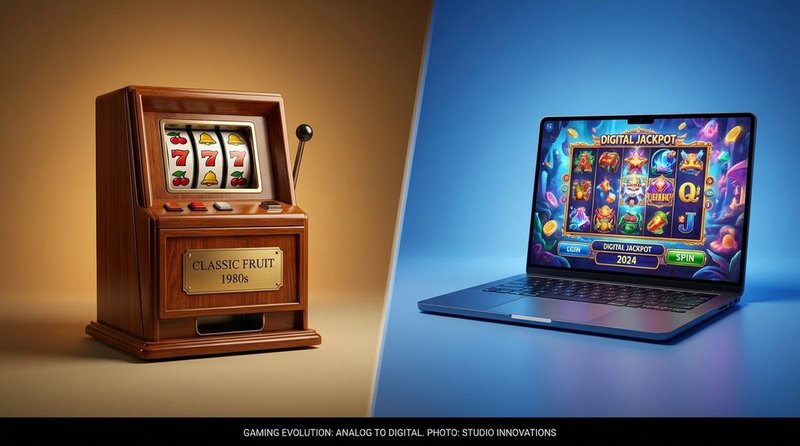
The technology that underpins modern online slot games did not emerge from software labs. It was developed, tested, and refined in British arcade cabinets and pub fruit machines across three decades. The migration from mechanical reels to digital platforms is a direct lineage — and understanding it matters for operators and suppliers working across both environments today.
The Mechanical Foundation: Reels, Stepper Motors and Early RNG
British fruit machines were technically ahead of their international counterparts from the 1970s onward. The mechanical infrastructure that drove them directly seeded the digital gaming formats that followed.
Early Amusement With Prizes (AWP) machines used fully mechanical reel systems: physical drums printed with fruit symbols, driven by spring-loaded mechanisms and stopped by solenoid-controlled brakes. Outcome was genuinely random in the purest sense — no processor, no algorithm, no weighting. The machines were profitable because prize structures were set conservatively relative to the stake, not because outcomes were managed.
The transition to electro-mechanical designs in the late 1970s introduced the first stepper motors: electric motors that move in discrete angular increments, allowing a processor to control precisely where each reel stops. In the UK, this shift happened rapidly. By the early 1980s, manufacturers including Bell-Fruit Manufacturing — founded in Nottingham in 1963 and one of the dominant forces in the British market — and Barcrest, established in Manchester, were shipping machines that combined physical spinning reels with microprocessor-controlled stop positions.
The critical addition was the random number generator. As the Gambling Commission’s own technical documentation confirms, RNG-controlled stepper motor machines work through a look-up table: the processor draws a number from the RNG, maps it to a position in the table, and instructs each stepper motor to stop at the corresponding reel position. The physical reel spins, but the outcome is determined the instant the player presses the button — the reel animation is theatrical confirmation of a result already selected.
What made British machines distinctive — and commercially influential — was a set of interactive features that had no direct equivalent in American or European slot machines. Nudge and hold mechanics, first introduced by Carfield Engineers in the late 1970s, transformed the AWP from a pure chance machine into something that required player decision-making. Nudge allows a player to advance a reel one position after a spin; hold allows selected reels to remain in place while others re-spin. These features were introduced partly to satisfy a peculiarity of UK gambling law that required an element of skill for certain prize structures to remain lawful. The legal rationale has since been superseded, but the mechanics persisted because players responded to them — and the feature set they inspired became foundational to modern bonus-round design.
Trail bonuses, feature boards, and gamble ladders — all standard in 1980s and 1990s UK fruit machines — gave players something to chase beyond a single spin outcome. The architecture of a main game with a triggerable bonus feature, escalating through a sequence of steps or choices, is the direct ancestor of the multi-stage bonus rounds that define online slot design today.
For a detailed technical breakdown of AWP machine categories and their regulatory classification, see the guide to AWP machines explained.
The Digital Transition: Video AWPs and Touchscreen Cabinets
From the mid-1990s, software-defined game logic began replacing the mechanical constraints of stepper-reel machines. The physical reel did not disappear — it remains in production today — but a new format emerged alongside it that would prove far more influential on what followed.
Video AWPs replaced spinning drums with LCD or CRT displays showing animated reel graphics. The game logic was identical to a stepper-reel machine — RNG draw, table lookup, position resolution — but the physical constraint of a mechanical reel with a fixed number of symbol positions was gone. Software could define any number of reel positions, any symbol weighting, any payline configuration. Game designers were no longer limited by what could be printed on a physical drum or what a stepper motor could reliably stop on.
Barcrest was among the earliest UK manufacturers to invest heavily in video AWP development, shipping video titles for pub and Adult Gaming Centre (AGC) deployment through the 1990s. Bell-Fruit’s Mazooma division became a significant video AWP developer in the early 2000s, producing titles that moved the genre toward the feature-rich, multi-level bonus format that would later define online slots. The company was acquired by Novomatic — the Austrian manufacturer that had entered the UK market through its 2004 acquisition of Astra Games — which brought Bell-Fruit, Mazooma, Empire, and Gamestec under a single corporate structure.
Touchscreen interfaces arrived in UK AGC and pub environments in the early 2000s. The operational advantage was immediate: touchscreen video AWPs eliminated the mechanical wear associated with button panels and allowed game interfaces to be reconfigured through software updates rather than physical cabinet modifications. A single touchscreen cabinet could carry multiple game titles selectable from an on-screen menu — the server-based gaming model that is now standard in online environments was being prototyped on UK arcade floors two decades ago.
The cabinet formats and machine types that emerged from this period are covered in detail in the arcade cabinet types guide.
From Cabinet to Server: How Online Slots Inherited Arcade DNA
When the first regulated online casinos launched in the late 1990s, the companies that built the software were, in several cases, the same companies that had been building physical fruit machines for the British pub and arcade trade.
Barcrest is the clearest example of this continuity. Founded in Manchester and operating as a major UK fruit machine manufacturer from the 1960s, Barcrest was acquired by International Game Technology (IGT) in 1998. IGT — already the dominant supplier of land-based slot machines in Las Vegas — held Barcrest until 2011, when Scientific Games (subsequently renamed Light and Wonder) acquired it as part of a broader consolidation of UK gaming assets. Light and Wonder also holds Bally Technologies, WMS Industries, and NYX Gaming Group, giving it one of the most extensive cross-channel portfolios in the global gaming market.
Barcrest’s online titles — including the Rainbow Riches series, first released in 2006 — retain the structural DNA of the physical fruit machines the company spent four decades producing. The multi-level bonus, the pick-me feature, the trail mechanic: these are AWP feature conventions translated into HTML5 and rendered on a browser screen rather than a CRT mounted in a pub cabinet.
IGT itself maintains a dual land-based and online presence. The company pioneered wide-area progressive jackpot systems in the US land-based market — Nevada Megabucks, launched in 1986, was the first wide-area progressive with a $1 million base jackpot — and now operates across both physical machine supply and online game development. Its 2023 launch of an omnichannel Wheel of Fortune progressive link, spanning land-based machines and online play in New Jersey simultaneously, illustrates how far the convergence has progressed.
Novomatic, having built a UK land-based portfolio through its acquisitions of Bell-Fruit, Mazooma, and Astra Games, expanded online through its 2010 acquisition of a controlling stake in Greentube, a Vienna-based online game developer. The same company that operates more than 270 Luxury Leisure venues in the UK — many of them in traditional seaside amusement locations — also operates a UKGC-licensed online casino under the Admiral Casino brand.
The specific UK mechanics that made British fruit machines unusual — nudge, hold, gamble feature, trail bonus — transferred into online slots with varying degrees of directness. The gamble feature (offer the player a 50/50 double-or-nothing on a win) appears in a substantial proportion of UK-market online slot titles today. Trail features, where a bonus counter advances through a sequence of escalating prizes, remain a recognisable structural element in titles from UK-heritage developers. Nudge and hold appeared in some early online slots but have become less common as the genre has developed its own visual language — though their conceptual descendants, in the form of win-both-ways respin mechanics and sticky wild holds, remain standard.
RNG and RTP: The Technical Thread from Arcade to Online
The RNG in a physical AWP machine and the RNG in an online slot game are functionally the same mechanism — a pseudo-random number generator (PRNG) that produces an unpredictable sequence of outputs from a seeded starting value. The implementation differs in detail; the principle is identical.
In a physical stepper-reel machine, the PRNG runs continuously while the machine is powered, sampling at a rate that makes the exact moment a player presses the spin button the effective source of randomness. In an online slot, the PRNG is seeded server-side at the point of each spin request, with the seed value combining system-time data and additional entropy sources. The result is statistically indistinguishable: neither the player nor the operator can predict or influence the outcome.
Return to Player (RTP) percentages differ significantly between the two environments, for reasons rooted in economics rather than technology. A Category C AWP — the standard pub fruit machine — carries no statutory minimum RTP. In practice, published figures for Category C machines typically range from 70% to 85%: the machine returns between 70p and 85p for every £1 staked, on average, over a sufficient number of plays. Online slots licensed by the UKGC typically operate between 94% and 97% RTP. The gap exists because the cost base of a physical machine — rent, staff, maintenance, electricity, coin handling — requires a higher house margin to sustain profitability. An online slot carries marginal incremental cost per game round; the economics support a higher return to the player.
What the two environments share is the testing and certification regime. The UKGC requires that all gaming machines placed for play in Great Britain — physical or digital — carry certification from an approved test house confirming that the RNG meets the Commission’s technical standards and that the stated RTP is achievable. Approved test houses active in both land-based and online certification include Gaming Laboratories International (GLI), BMM Testlabs, iTech Labs, and NMi Gaming. For online casino games, eCOGRA — established in 2003 and based in the UK — operates as a widely used UKGC-approved testing and certification body alongside the established test laboratories.
The practical significance for operators is that the RNG in the physical cabinet on an AGC floor and the RNG in an online slot from the same developer have passed through the same category of regulatory scrutiny, administered by the same regulator, against standards that share a common technical lineage.
Full detail on UKGC technical standards for AWP machines is in the Gambling Commission AWP rules guide, and the broader regulatory framework is covered in the UK amusement machine regulations overview.
What This Means for UK Operators and Suppliers
The convergence between land-based arcade operations and online gaming is not a future trend — it is an existing operational reality for the largest companies in both sectors. For UK amusements operators and suppliers, this has several practical implications.
Regulatory familiarity is transferable. Any AGC or licensed Family Entertainment Centre (FEC) operator who understands UKGC LCCP obligations, machine technical standards, RTP certification, and responsible gambling requirements already understands the foundational regulatory layer that applies to UKGC-licensed online operators. The frameworks are not identical — remote operating licences carry additional conditions, particularly around financial vulnerability checks and online-specific customer interaction obligations — but the common ground is substantial. Operators working across both environments do not start from a regulatory blank sheet.
Suppliers are increasingly structured to serve both channels. Electrocoin, the UK distributor active since 1976 whose BAR X and OXO titles are fixtures on British AGC floors, occupies a different part of the market from Barcrest or Novomatic, but the broader supply chain — from test house certification to software development tools — is converging. Sega Amusements International and Bandai Namco Amusements Europe, both significant FEC suppliers, are also active in game licensing discussions that touch the digital entertainment space. The line between coin-op amusements and licensed gaming products is commercially blurred in ways that were not true twenty years ago.
Cashless play and networked cabinets further close the gap. Server-based gaming systems — where game content is delivered to terminals from a central server and player accounts are managed centrally — operate on architecture that is structurally similar to online casino back-end systems. TITO (Ticket In, Ticket Out) systems on UK AGC floors are a simplified version of the same principle: removing the coin from the transaction and replacing it with a tracked digital credit. As cashless payment becomes standard across UK FEC and AGC environments, the operational distinction between a physical machine and an online game terminal narrows further.
Industry events reflect the convergence. EAG — the amusements industry’s principal UK trade show — has for several years scheduled programming that explicitly addresses the overlap between land-based amusements and digital gaming. The background to that show is in the EAG Expo history piece. ICE Barcelona, which relocated from ExCeL London in 2024, covers the full spectrum from physical gaming machines to online casino software and is relevant for suppliers and operators active across both environments — practical detail is in the ICE Barcelona UK guide.
The regulatory framework governing all of this — land-based and online — sits within the Gambling Act 2005, administered by the UK Gambling Commission. Operators in the UK amusements sector already operate within that framework. The step from understanding how it governs a physical AWP machine to understanding how it governs an online slot licence is shorter than many assume.
Are online slots based on arcade fruit machines?
Yes, directly. The core mechanics of online slots — the RNG outcome engine, bonus round structures, gamble features, and multi-level trail bonuses — trace to physical AWP machines developed and refined in British pubs and arcades from the 1970s onward. Several of the largest online slot developers, including Barcrest (now part of Light and Wonder) and Novomatic, built their game design capabilities in the land-based UK amusements market before moving into online.
Do the same companies make arcade machines and online slots?
Many do. Barcrest, IGT, and Novomatic all operate across both land-based and online channels. Barcrest produced physical UK fruit machines for decades before its acquisition by IGT in 1998 and subsequent transfer to Light and Wonder in 2011; its Rainbow Riches online series is a direct continuation of game structures first developed for pub and AGC cabinets. Novomatic owns Luxury Leisure (UK AGC and seaside arcade venues) and Admiral Casino (UKGC-licensed online casino) within the same corporate structure.
Are arcade machines and online slots regulated by the same body in the UK?
In Great Britain, yes. Both physical AWP machines placed in licensed premises and online slot games offered to UK players fall under the jurisdiction of the UK Gambling Commission, operating under authority derived from the Gambling Act 2005. The UKGC sets technical standards, approves test houses for RNG certification, and issues operating licences for both land-based and remote gambling operators. Northern Ireland operates under separate legislation and falls outside the UKGC’s remit.
The technical and regulatory thread connecting land-based arcade cabinets to online slot platforms is direct and documented. The RNG that resolves a spin on a physical Category C machine in a British AGC and the RNG that resolves a spin on an online slot licensed by the UKGC operate on the same technical principles, are tested to the same category of standards by the same approved test houses, and are governed by the same regulator under the same primary legislation. Operators and suppliers working in the UK amusements trade are closer to the online casino sector than the apparent distance between a coin-op cabinet and a browser window might suggest — and the regulatory framework that governs both environments shares a common foundation in the Gambling Act 2005.