
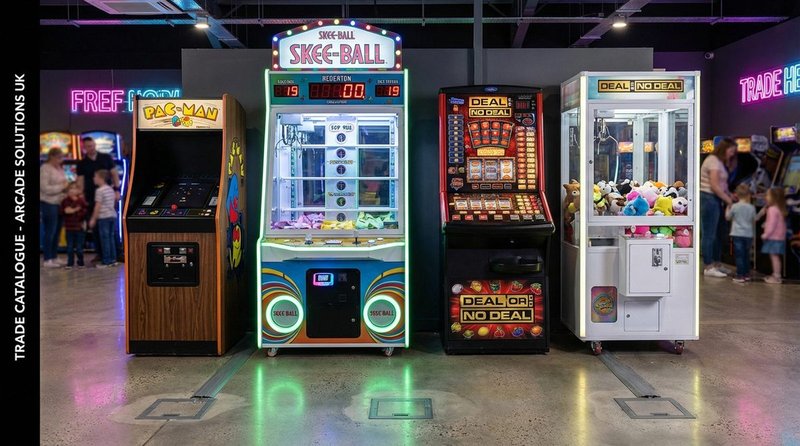
The arcade cabinet market in the UK has never been a single category. Walk the floor of any well-run FEC or AGC and you encounter a mix of machine types that each carry different regulatory requirements, different floor economics and different audience appeals. Operators who treat cabinet selection as a purely commercial decision — choosing whatever fills the floor cheapest — routinely underperform against those who understand the distinctions between a Category D redemption unit, a Skill-With-Prizes machine and a video upright. This guide covers the principal cabinet types available to UK operators, the regulatory framework each sits within, and the practical considerations that matter when purchasing or refreshing a floor.
Video Arcade Cabinets: Upright, Cocktail and Sit-Down Formats
Video arcade cabinets are the most operationally straightforward category for UK operators: no gambling licence is required, no stake limits apply, and the only regulatory obligations concern electrical safety, CE or UKCA marking, and general consumer safety legislation. The three primary formats — upright, cocktail and sit-down — each suit different environments.
Upright cabinets remain the dominant format. Standard footprints run 600–700mm wide and 750–900mm deep, making them manageable in corridors and along walls. Monitor sizes have migrated from the 19″ CRTs of the 1980s and 1990s to 27″–32″ LCD panels as standard on current production units, with some titles using twin-screen or vertical-orientation displays. Raw Thrills (distributed in the UK via specialist distributors) and Bandai Namco Amusements Europe produce the majority of the current high-throughput upright titles seen in UK venues.
Cocktail cabinets — low, table-height units with top-mounted screens — work well in licensed premises and family dining environments where players remain seated. They require more floor space per unit than uprights and generally carry lower throughput, but they attract a different demographic. Operators considering cocktail formats for pub or restaurant settings should review FEC permit vs licence requirements, as the venue classification can affect which machine categories are permissible.
Sit-down or environmental cabinets — racing simulators, gun games, motion-platform units — occupy the premium tier. Floor space requirements can exceed 2m² per unit and power draw may reach 1–2kW for motion-enabled machines, so both the electrical infrastructure and physical layout require planning before procurement. These units justify their footprint cost through higher per-play charges, typically £1–£2 per play in current UK FEC pricing.
All cabinets imported or manufactured for the UK market since January 2021 require UKCA marking rather than CE marking for new stock, though CE-marked product placed on the market before the transition period retains validity. Operators buying second-hand or refurbished units from European distributors should confirm marking status with the supplier.
Redemption Game Cabinets: Ticket-Out Mechanics and Floor Management
Redemption cabinets generate tickets proportional to player skill or score, redeemable at a prize counter. In UK FEC operations, they are the primary driver of dwell time and repeat play, particularly for the 6–14 age bracket.
The fundamental operational distinction is between paper ticket-out systems and electronic TITO (Ticket In, Ticket Out) card systems. Paper ticket redemption remains common in smaller seaside arcades and traditional AGCs, but TITO card systems — where credits accumulate on a magnetic-stripe or RFID card — have become the standard in larger FEC venues. TITO simplifies prize counter management, reduces ticket jamming downtime and provides operators with accurate per-machine yield data. Suppliers including Bandai Namco Amusements Europe offer TITO-integrated cabinets across their FEC ranges.
From a regulatory perspective, redemption games in the UK occupy a defined space under the Gambling Act 2005. Provided tickets cannot be exchanged for cash and the prize value remains within Category D limits, the machines operate as Category D gaming machines. Where redemption games offer prizes above Category D thresholds, they require a higher category licence. Operators should ensure prize catalogues are audited against current category limits; the Gambling Commission publishes current parameters and BACTA provides operator guidance on compliance.
Floor management considerations for redemption sections: ticket-heavy formats require daily hopper servicing and periodic cabinet cleaning to prevent ticket dust accumulation in mechanical components. Cabinet width on standard redemption units runs 600–800mm; larger crane-adjacent formats (such as ball-drop towers) can reach 900mm–1,100mm wide. Power requirements are modest — most units draw 200–400W — making redemption sections straightforward to plan around standard 13A or 16A circuits.
Skill-With-Prizes (SWP) Machines: Regulatory Position and Cabinet Design
SWP machines occupy the most legally nuanced position in the UK cabinet taxonomy. Under the Gambling Act 2005, a machine is a gaming machine if the outcome is determined wholly or partly by chance. A machine where outcome is determined entirely by player skill — and where prize values fall below the relevant thresholds — may fall outside the gaming machine definition entirely, removing the licensing requirement.
The practical application matters. Where an SWP machine offers non-monetary prizes of low value (under the Category D non-monetary prize limit), it typically requires no gaming machine licence. Where it offers cash prizes or higher-value prizes, it must be classified and licensed accordingly. The boundary between SWP and Category D is a regular area of operator enquiry, and the Gambling Commission’s guidance — as well as the Gambling Commission AWP rules — provides the relevant framework for assessment.
SWP cabinets in the UK market tend toward redemption-style physical formats: upright or semi-upright, 600–750mm wide, with joystick or button controls and a ticket or prize-dispense mechanism. The cabinet build quality varies considerably between manufacturers; operators should prioritise units with accessible internal mechanisms and documented UK parts supply chains, since specialist SWP cabinets from smaller manufacturers can present parts sourcing problems after three to five years in service.
AWP Cabinets in the UK: Reel-Mechanical vs. Video AWP
AWP machines — Amusement With Prizes — are gaming machines under the Gambling Act 2005 and constitute the core revenue unit for most traditional UK AGCs and many FECs. The two principal formats are reel-mechanical AWPs and video AWPs, each with distinct operational profiles.
Reel-mechanical AWPs use physical spinning reels — typically three, occasionally five — driven by stepper motors, with outcome determination via an RNG. They remain popular with a traditional adult audience and are strongly associated with the Category C classification (maximum stake £1, maximum prize £100). UK-specific cabinet design conventions — the distinctive tall, narrow format of classic fruit machines — remain standard from manufacturers including Electrocoin, whose uprights are a common presence on British AGC floors. The full regulatory framework governing AWP operations, including Machine Games Duty obligations, applies to all AWP category machines.
Video AWPs use large touchscreen or LCD displays — typically 22″–32″ — to simulate reel games or deliver bonus-feature content. They dominate new installs in adult gaming centres and some FEC adult sections. Video AWPs can carry richer feature sets than mechanical reels and are more easily updated through software, but they require more rigorous screen maintenance and are more susceptible to vandalism in high-throughput environments. Category C and Category D video AWP formats exist; operators should confirm category classification with the manufacturer before siting, particularly where venue licence types restrict certain categories. Full compliance requirements are covered in the guide to UK gaming machine categories.
Both reel and video AWPs require a premises licence or permit permitting gaming machines, and operators must comply with age verification requirements for Category C machines, which are restricted to adults.
Coin Pusher and Penny Fall Cabinets
Coin pushers and penny falls remain a fixture of UK seaside and traditional amusement arcades. They are classified as Category D gaming machines and are subject to specific stake and prize limits introduced by SI 2009/1502 and subsequently amended.
The current regulatory position for coin pusher and penny fall machines in the UK sets a maximum stake of 20p per play and a maximum prize of £20 (of which no more than £10 may be in cash) under the Categories of Gaming Machine (Amendment) Regulations 2014. These updated the previous SI 2009/1502 limits of 10p stake and £15 prize. Operators running coin pushers with cash prize components should verify current limits directly against Gambling Commission guidance, as the rules differ between pure token/prize-coin machines and those dispensing cash.
Cabinet formats range from single-player countertop units to wide multi-player floor-standing cabinets spanning 1.2m–2.4m. The floor-standing multi-player format is the standard commercial unit. Power draw is low — typically 150–300W — and maintenance requirements centre on coin mechanism servicing and prize coin hopper management.
Venue classification matters for penny falls. Under the Gambling Act 2005, Category D machines can be sited in a wider range of venues than Category C, including unlicensed FEC environments subject to a permit rather than a full premises licence. Operators new to the sector should review the FEC permit vs licence distinction before committing to a floor plan that assumes full Category D availability.
Crane and Claw Machine Cabinets
Crane machines — also called claw machines or grabber machines — offer a non-monetary prize (a plush toy or other physical item) with no cash equivalent. Because no cash prize is involved and outcome is presented as skill-based, standalone crane machines in FEC environments generally do not require a gaming machine licence under UK law, provided prizes are physical items and no cash or token redemption for cash is available.
Cabinet formats include single-player uprights (typically 700–900mm wide) and larger multi-player or side-by-side configurations used in high-traffic FEC entrances. Power draw is low, typically 200–350W per unit. Current UK market supply comes primarily through distributors handling Elaut (Belgian manufacturer), Bandai Namco Amusements Europe, and specialist importers. Lead times from order to delivery have extended in recent years; operators planning floor refreshes should build in 8–14 weeks from order for new units.
Key Buying Considerations for UK Operators
Cabinet selection involves four practical dimensions that experienced operators rank ahead of headline price: power infrastructure, floor space yield, maintenance access, and parts supply.
Power and Electrical Infrastructure
UK mains supply is 240V/50Hz. All cabinets supplied for the UK market must be rated for this supply and carry appropriate CE or UKCA marking. Imported North American cabinets — particularly Raw Thrills titles bought direct from US distributors — are manufactured for 120V/60Hz and require a step-up transformer or power supply conversion before UK operation. The conversion cost and ongoing transformer maintenance are often underestimated in total cost of ownership calculations. Motion-platform and large sit-down simulators may require 32A dedicated circuits; confirm power requirements with the supplier before installation and involve a qualified electrician in the site survey.
Floor Space Yield
Revenue per square metre is the meaningful metric, not revenue per machine. A compact redemption upright generating £200 per week from a 0.6m² footprint outperforms a large sit-down simulator generating £350 per week from 2.5m². Operators should model floor yields at the planning stage, particularly when mixing AWP, redemption and video cabinet types.
Maintenance Access and Design
Service access — rear-access vs. front-access cabinet design — determines whether machines can be maintained without moving them from their sited position. In tightly packed arcade layouts, front-access cabinets are strongly preferable. Check that coin mechanisms, bill validators (where fitted), ticket hoppers and main PCBs are accessible from the front. Many imported cabinets are designed for US FEC floor plans where rear access is assumed; on a narrow UK arcade floor, this creates operational friction.
Parts Supply
UK operators should confirm UK-based parts availability before purchase. Key questions: does the UK distributor hold a parts stock, or is everything ordered from the manufacturer? What is the typical lead time for a main PCB or monitor replacement? Budget parts costs into the five-year ownership model: for a high-throughput cabinet, annual maintenance cost typically runs 8–15% of purchase price.
Frequently Asked Questions
Do I need a gambling licence to operate video arcade cabinets?
No. Pure video arcade cabinets — where players pay to play a game with no monetary prize — are not gaming machines under the Gambling Act 2005 and require no gaming machine licence. Standard consumer safety and electrical safety obligations apply, as does UKCA or CE marking for the equipment itself.
What is the difference between a Category C and Category D AWP in a UK arcade?
Category C machines permit a maximum stake of £1 and a maximum prize of £100. Category D machines permit a maximum stake of 10p (for cash prize variants) and a maximum prize of £5 in cash. The venue licence or permit determines which categories can be sited; a standard FEC permit typically allows Category D only, while a full AGC premises licence permits Category C. Full details are in the guide to UK gaming machine categories.
Can I import a US arcade cabinet and operate it in the UK without modification?
Not safely, and not legally without modification. North American cabinets are manufactured for 120V/60Hz supply; UK mains is 240V/50Hz. Operating without a step-up transformer or power supply conversion risks equipment damage and poses a fire and safety risk. All equipment operated commercially in the UK must carry appropriate UKCA (or CE for pre-2021 stock) marking confirming conformity with UK electrical safety standards.
Are crane/claw machines classed as gaming machines under UK law?
Standalone crane machines offering only physical, non-cash prizes are generally not classified as gaming machines under the Gambling Act 2005, because the prize has no monetary value. However, if the machine is sited in a licensed gaming premises, or if prizes can be exchanged for cash or tokens redeemable for cash, the classification changes. Operators should confirm the position with a solicitor experienced in gambling law or refer to BACTA guidance for their specific setup.
Many of the video game mechanics now standard in online gaming products — cascading reels, bonus rounds triggered by player interaction, and progressive jackpot displays — were first developed and refined in coin-op arcade cabinets during the 1980s and 1990s. The transition from physical cabinet to digital platform has been direct: several mechanics originally patented for upright arcade use now underpin online slot titles licensed by the UK Gambling Commission. Understanding the hardware origins of these mechanics gives operators and developers a clearer picture of why certain game structures perform consistently across both physical and digital environments.