
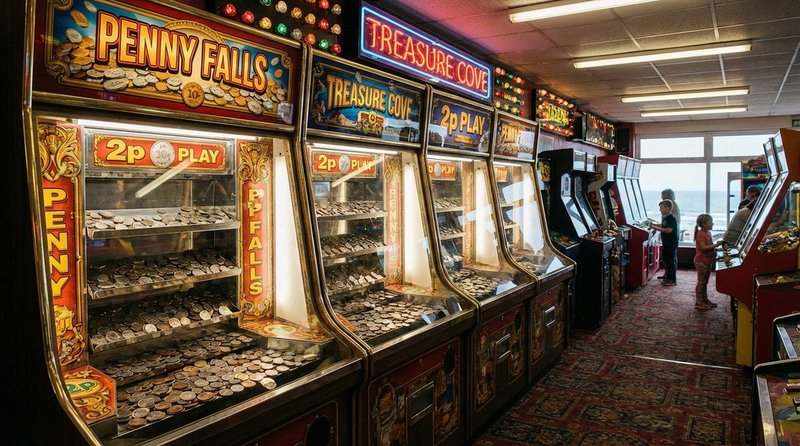
Coin pushers — or penny falls, as much of the trade still calls them — are the closest thing the UK amusements industry has to a universal machine. From Blackpool to Broadstairs, they occupy the front-of-house position in seaside arcades, generating footfall and coin throughput on margins that more complex cabinets rarely match. For operators, the regulatory picture has been reasonably stable since the 2014 Amendment Regulations settled the current stake and prize limits. What follows is a practical guide to classification, siting, equipment and revenue management.
What Is a Coin Pusher? Mechanics and Player Appeal
A coin pusher is a Category D gaming machine in which the player inserts a coin onto a moving shelf, hoping to dislodge coins — and occasionally prizes — that overhang the collection tray. The mechanic is straightforward: coins accumulate on one or two shelves driven by a reciprocating motor; the player’s inserted coin lands on the upper shelf and, if positioned correctly, exerts enough force on the coin mass below to push items over the edge. The randomness lies in shelf position at the point of insertion, the coin stack configuration, and the machine’s fill level.
Player appeal rests on three factors. First, near-miss visibility — players can see coins and prizes teetering on the shelf edge, which drives repeat play. Second, low denomination entry — the ability to play for 2p or 10p per go makes penny falls accessible to children and adults who would not approach a higher-stake machine. Third, the tactile, analogue nature of the mechanic, which has proved resistant to digital alternatives in the family arcade context. Seaside operators consistently report that penny falls occupy a disproportionate share of floor space relative to their individual GGY because of the dwell time they generate.
UK Regulatory Category: Category D Classification and Limits
Coin pushers are Category D gaming machines under the Gambling Act 2005, classified specifically as a distinct sub-type within that category. The current limits — 20p maximum stake, £20 maximum prize (of which no more than £10 may be in cash) — were set by the Categories of Gaming Machine (Amendment) Regulations 2014. Category D carries no age restriction; children may legally play coin pushers.
The Category D classification sits alongside other sub-types including money-prize AWP machines (10p stake, £5 cash prize) and crane grabs (non-monetary prize). Coin pushers occupy a distinct regulatory position within Category D — their prize limit of £20 is four times that of the standard Category D money-prize AWP, reflecting the lower frequency of large payouts and the mixed cash/non-monetary prize structure. For a full overview of all UK gaming machine categories and how they interact with premises licensing, the complete guide covers each type in detail.
Prize Limits and the 2009/2014 Regulatory History
The current coin pusher limits are the product of two successive amendments to the original Categories of Gaming Machine Regulations 2007 (SI 2007/2158). Operators should understand both, as the 2009 instrument is sometimes cited in older supplier literature with figures that are no longer current.
SI 2007/2158 established the original Category D framework but did not create a specific coin pusher sub-category. Penny falls at that point operated under the general non-monetary prize Category D limits.
The Categories of Gaming Machine (Amendment) Regulations 2009 (SI 2009/1502) introduced the first dedicated coin pusher and penny falls sub-category, defining these as machines where play involves inserting a coin onto a moving shelf. The 2009 instrument set specific limits: maximum stake 10p, maximum prize value £15, of which no more than £8 could be a money prize. This was a meaningful uplift from the default non-monetary prize Category D limits and acknowledged the mixed cash/non-cash nature of typical penny falls payouts.
The Categories of Gaming Machine (Amendment) Regulations 2014 increased both parameters. Maximum stake rose to 20p; maximum prize rose to £20, of which no more than £10 may be in cash. These remain the operative limits. The 2014 amendment also increased the lower-rate threshold for Machine Games Duty — operators whose machines have a maximum stake of 20p or less now qualify for the 5% lower rate rather than the standard 25% rate, which has direct implications for coin pusher revenue modelling.
Token and Ticket-Out Variants: A Separate Regulatory Position
Modern coin pusher variants that pay in tickets rather than cash — so-called ticket-out pushers — or that operate on tokens rather than circulating 2p and 10p coins occupy a different regulatory position. Ticket payout is a non-monetary prize for the purposes of Category D classification. Where the machine pays solely in tickets redeemable for merchandise, it may fall outside the coin pusher sub-category definition and into the broader non-monetary prize Category D framework. Operators introducing ticket-out pushers should confirm classification with their supplier or seek advice through FEC permit conditions, as the applicable prize limits differ.
Siting: Where Coin Pushers Can Legally Operate
As Category D machines, coin pushers can be sited in any premises permitted to offer Category D gaming machines. This covers a broad range of venue types, which is one of the commercial advantages of coin pushers over higher-category machines.
The most common siting contexts are:
- Unlicensed Family Entertainment Centres (FECs): The primary venue type for coin pushers in the UK. An unlicensed FEC holds a permit from the local licensing authority — no Gambling Commission operating licence is required, provided the machine offering is limited to Category D. An unlicensed FEC permit is valid for ten years and carries no per-machine annual fee.
- Licensed FECs and Adult Gaming Centres: Venues holding a UKGC operating licence and a premises licence may also site coin pushers alongside Category C and B3 machines. Coin pushers remain Category D and subject to the same limits.
- Travelling fairs: Category D machines, including coin pushers, may be operated at travelling fairs occupying land for no more than 27 days per calendar year, without any permit requirement under Gambling Act 2005 exemptions.
- Licensed premises (pubs): A pub holding an alcohol licence has an automatic entitlement to up to two Category C or D machines. A coin pusher counts as one Category D machine against this entitlement.
Key Manufacturers and Models Available in the UK
The UK coin pusher market is served by a relatively small group of manufacturers and distributors.
Bandai Namco Amusement Europe is the most active manufacturer in the UK coin pusher segment, with a range of licensed-IP pushers that have become standard FEC hardware — including the DC Superheroes Pusher, a four-player closed-loop pusher with ticket payout and collectable trading cards. These machines operate on tokens with ticket payout, placing them in the non-monetary prize Category D sub-type. Their commercial strength lies in brand recognition and the collectable card mechanic, which drives repeat play in FEC environments.
Electrocoin, based in the UK, is a long-established distributor and manufacturer serving the British amusements trade. Electrocoin’s catalogue includes traditional penny falls hardware alongside newer redemption-adjacent pushers. As one of the few operators with direct UK production and servicing capability, Electrocoin is a common first point of contact for operators looking to place or replace pusher hardware, particularly in seaside and pier venues where traditional coin-circulation models remain standard.
Traditional penny falls in the UK — multi-shelf coin-circulation machines representing the classic seaside product — are generally sourced from specialist manufacturers and refurbished through the secondary market. New-build traditional pushers are available, but the capital cost per unit for a multi-shelf machine (typically £3,000–£8,000 depending on shelf count and condition) means that refurbished machines circulate actively within the trade.
Maintenance, Coin Fill and Revenue Management
Coin fill management is the primary operational cost for coin pusher estates — and the variable that most directly determines whether a pusher earns its floor space.
Traditional penny falls circulate 2p and 10p coins. The machine must maintain sufficient coin depth on both shelves to sustain player interest — an underfilled pusher with large visible gaps on the shelf surface generates less play. Coin recirculation — where the machine retains coins that fall into the collection mechanism and returns them to the hopper — is standard on commercial pushers and is the mechanism by which the machine maintains a positive take. Operators should monitor the recirculation mechanism regularly; a machine that is overpaying due to a faulty recirculator can erode weekly takings significantly before the fault is identified on the cash count.
Weekly servicing should cover: coin count and cash reconciliation, shelf mechanism lubrication, coin sensor cleaning, prize deck inspection, and ticket printer servicing on ticket-out models.
Revenue benchmarking varies considerably by location. A well-sited penny falls machine in a busy seaside FEC during peak summer season may generate £200–£400 weekly gross. The same machine in a quieter inland FEC may produce £40–£80. Coin pushers generate lower gross gaming yield (GGY) per machine than AWP machines, but carry less regulatory overhead and their dwell-time contribution to overall arcade revenue is consistently valued by operators with mixed-estate venues.
Frequently Asked Questions
Do coin pusher machines require a Gambling Commission licence?
No — not if the premises is operating solely Category D machines. A Family Entertainment Centre holding an unlicensed FEC permit from the local licensing authority can site coin pushers without a Gambling Commission operating licence. A UKGC licence is only required if the premises also wishes to offer Category C or above machines.
What are the current stake and prize limits for coin pushers in the UK?
The current limits are: maximum stake 20p per play, maximum prize value £20, of which no more than £10 may be in cash. These limits were set by the Categories of Gaming Machine (Amendment) Regulations 2014, which updated the previous 2009 limits of 10p stake and £15 maximum prize. Ticket-out and token-only machines may fall under different Category D sub-type limits depending on their prize mechanism.
Are coin pushers subject to Machine Games Duty?
Coin pushers that pay cash prizes are dutiable machine games for MGD purposes. However, because their maximum stake is 20p or less, they qualify for the lower rate of MGD — currently 5% of net takings, rather than the standard 25% rate. Machines that pay only non-monetary prizes (tickets, merchandise) are generally outside the scope of MGD, but operators should verify their specific configuration against HMRC Excise Notice 452.
The near-miss dynamic that makes coin pushers so effective in the physical arcade — coins visibly teetering on the shelf edge, the player certain that one more go will tip the balance — has long interested researchers studying player behaviour across gaming formats. The same perceptual mechanisms are well documented in online slot design, where the visual proximity of matching symbols to a winning line performs a structurally similar function. Operators working across both land-based and online gaming contexts will recognise the underlying psychology, even as the regulatory frameworks governing each format diverge considerably.