
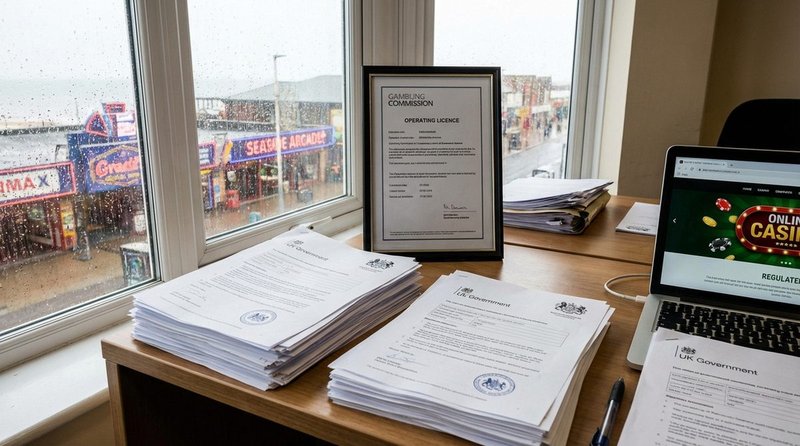
The UK Gambling Commission licences both the land-based amusements sector and the online casino industry under the same primary legislation — the Gambling Act 2005. But the licensing structures, compliance obligations and operational requirements diverge significantly. For operators, suppliers or investors working in one sector and considering the other, the differences matter more than the similarities.
This article sets out a direct comparison across the dimensions that matter most: the licence types each sector requires, the compliance obligations each carries, how tax is applied, and how enforcement works in practice. It is written for readers who know one side of the fence and are evaluating the other.
The Common Foundation: Gambling Act 2005 and the UKGC
Both sectors operate under a single primary statute and a single national regulator. The Gambling Act 2005 is the legislative foundation for all commercial gambling in Great Britain; the UK Gambling Commission (UKGC) is the regulator for both land-based and online activity. Northern Ireland is governed by separate legislation and sits outside the UKGC’s remit.
The Commission’s Licence Conditions and Codes of Practice (LCCP) applies to all operating licence holders regardless of whether they operate venues, machines, or websites. The LCCP is divided into licence conditions (mandatory obligations) and codes of practice (expected standards). Both land-based AGC operators and online casino operators holding UKGC licences are bound by it.
The three licensing objectives established by the 2005 Act are the same across both sectors:
- Preventing gambling from being a source of crime or disorder, or being associated with crime or disorder, or being used to support crime.
- Ensuring that gambling is conducted in a fair and open way.
- Protecting children and other vulnerable persons from being harmed or exploited by gambling.
The UKGC holds the same enforcement toolkit whether the operator runs a seafront arcade or a licensed online slots platform: financial penalties, formal warnings, licence review, suspension, and revocation. The Commission has used all of these against both land-based and remote operators in recent years.
Land-Based Licensing: Operating Licence Plus Premises Licence
Land-based operators need two separate authorisations: a UKGC operating licence for the activity type, and a premises licence from the local licensing authority for each physical location. Neither alone is sufficient.
The UKGC operating licence covers the specific type of gambling activity. For the amusements sector, the relevant categories are:
- Adult Gaming Centre (AGC) operating licence — authorises unlimited Category B3, C, and D gaming machines in a dedicated adult premises.
- Licensed Family Entertainment Centre (FEC) operating licence — authorises Category C and D machines in a mixed-age environment with a physically segregated adult area.
- Bingo operating licence — for bingo halls, which may also hold gaming machines within defined limits.
- Betting operating licence — for licensed betting offices, which may offer specific machine categories alongside betting.
The premises licence is a separate authorisation issued by the local council, specific to each physical site. An operator opening a second AGC location must obtain a second premises licence. This two-tier structure means that a change of premises — or a new site — triggers a full local authority application process, independent of the UKGC operating licence already held.
Personal Management Licences (PMLs) are required for individuals occupying specified management roles within a licensed operation: chief executive, chief financial officer, and other positions where the individual has a key influence on conduct of the licensed activity. PMLs are held by the individual, not the company. For small operators where the owner is also the day-to-day manager, this often means the operator personally holds a PML.
Annual fees to the UKGC are calculated based on the number of premises and the operator’s gross gambling yield band. Full detail on the permit and licensing framework for each premises type is covered in our guide to UK amusement machine regulations, and the specific comparison between FEC permit routes is addressed in licensed vs unlicensed FECs.
Online Licensing: Remote Operating Licence
Online operators do not require a premises licence. There is no physical venue, so the local authority tier drops out entirely. What remains is more demanding at the UKGC level: a single Remote Operating Licence, but with a more intensive application process and broader ongoing compliance obligations than the land-based equivalent.
The Remote Operating Licence types relevant to online casino activity include:
- Remote casino operating licence — for operators offering online casino games including slots, table games, and live dealer.
- Remote betting operating licence — for sports betting and exchange platforms.
- Remote bingo operating licence — for online bingo products.
- Gambling software operating licence — required for businesses that supply gambling software to licensed operators, rather than operating direct-to-consumer products themselves.
Personal Management Licences apply here too. Key individuals in senior roles at UKGC-licensed online operators must hold PMLs, subject to the same fit-and-proper assessment as their land-based counterparts.
The territorial reach of the Remote Operating Licence is broad. Under the Gambling (Licensing and Advertising) Act 2014, any operator offering online gambling to customers in Great Britain must hold a UKGC licence — regardless of where the operator is incorporated or based. An operator incorporated in Malta, Alderney, or Gibraltar that accepts GB customers without a UKGC remote licence is in breach of UK law. This extraterritorial reach has significantly expanded the UKGC’s regulatory perimeter since 2014 and is a critical distinction from the land-based regime, where the licensing obligation is anchored to a physical premises in Great Britain.
The application process for a Remote Operating Licence is more rigorous than for most land-based equivalents. Applicants must submit financial projections, a detailed responsible gambling plan, Anti-Money Laundering (AML) procedures, technical architecture documentation, and evidence of key personnel suitability. Enhanced due diligence on the business and its principals is standard. Processing times for remote casino applications typically run longer than for AGC or FEC operating licence applications.
Compliance Obligations: What Each Side Must Do
Both sectors share a regulatory baseline under the LCCP, but the specific obligations diverge meaningfully once you move beyond the core principles. The gap is widest in customer verification and automated player protection.
Obligations common to both sectors
- Anti-Money Laundering (AML): Both land-based AGC operators and remote casino operators holding UKGC licences are subject to the Proceeds of Crime Act 2002 and must maintain AML policies, procedures, and controls. Customer due diligence (CDD) is required when risk thresholds are met. Both must submit Suspicious Activity Reports (SARs) to the National Crime Agency where required.
- Responsible gambling: Both must operate self-exclusion schemes, identify vulnerable customers, and train staff. Both are bound by the LCCP’s social responsibility codes.
- Regulatory returns: Both must submit regular activity data to the UKGC, including customer complaints data and details of self-exclusions.
Land-based specific obligations
- Challenge 25 policy: Physical age verification at point of access to adult gaming areas. Any customer who appears to be under 25 must present proof of age before accessing Category B or C machines.
- Physical segregation: Licensed FEC and AGC operators must maintain physically separate areas for adult-only machine categories, with compliant signage at the entrance.
- Staff training records: LCCP requires that staff in licensed venues have documented responsible gambling training. BACTA’s self-exclusion scheme is the standard mechanism for BACTA member operators; the BACTA framework is described in our guide to BACTA UK.
- KYC approach — observation-based: In a land-based venue, age and identity checks are conducted at the point of access to restricted areas. There is no requirement to verify identity electronically before a customer plays a machine; the obligation is to challenge customers who appear to be under the required age.
Online specific obligations
- Electronic age and identity verification before first deposit: Online operators must verify a customer’s age and identity before allowing any gambling to take place. A customer cannot deposit or play until their identity is confirmed — not after, and not on a provisional basis.
- GamStop integration: All UKGC-licensed remote operators must be enrolled in GamStop, the national online self-exclusion scheme. A customer registered with GamStop is blocked at the point of account creation or login across all participating operators.
- Affordability checks: The UKGC introduced enhanced financial risk checks from July 2024. Operators must carry out frictionless background financial risk checks on customers spending above defined thresholds, with enhanced checks at higher spending levels.
- Session time limits and autoplay restrictions: Remote casino operators must display session time information prominently and allow customers to set session time limits. Autoplay — where a slot spins continuously without the player initiating each spin — has been restricted under the 2021 online slots regulations.
- £5 maximum stake for online slots: Introduced in September 2021, the £5 per spin maximum stake applies to all online slot games on UKGC-licensed platforms. There is no equivalent single-stake cap across all Category C land-based machines (Category C maximum stake is £1; Category B3 is £2).
- Age verification for arcades: For land-based operators, the specific requirements are covered in our guide to age verification in arcades.
The structural difference in KYC approach reflects the different operating environments. Land-based relies on staff observation, physical barriers, and challenge policies — human systems operating at the point of access. Online relies on technology: identity verification APIs, database checks against credit reference agencies, GamStop cross-referencing, and automated affordability assessment. Online KYC is front-loaded and data-intensive in a way that has no direct land-based equivalent.
Tax Structures: MGD vs Remote Gaming Duty
The two sectors pay separate duties to HMRC under different regimes. Neither duty is calculated the same way as the other, and both operate independently of corporation tax.
Machine Games Duty (land-based)
Land-based gaming machine operators pay Machine Games Duty (MGD) to HMRC on the net takings from dutiable machines — gross receipts minus prizes paid. MGD replaced Amusement Machine Licence Duty (AMLD) in February 2013 and is governed by HMRC’s Excise Notice 452.
MGD has three rate tiers:
| Machine Type | Max Cost to Play | Max Cash Prize | MGD Rate |
|---|---|---|---|
| Type 1 (Lower) | 20p | £10 | 5% |
| Type 2 (Standard) | £5 | Any | 20% |
| Type 3 (Higher) | Over £5 | Any | 25% |
Source: HMRC Excise Notice 452; The Machine Games Duty (Types of Machine) Order 2014, SI 2014/47.
For HMRC’s 2024/25 financial year, MGD receipts totalled £609 million across Great Britain. Full detail on MGD registration, net takings calculation, monthly returns, and exempt machines is in our complete MGD guide for arcade operators.
Remote Gaming Duty (online)
Online casino operators pay Remote Gaming Duty (RGD) to HMRC at a rate of 21% of gross gambling yield — stakes received minus prizes paid to players. RGD is a point-of-consumption tax: operators pay on all gross gambling yield generated from GB customers, irrespective of where the operator is incorporated or where its servers are located. An operator based in Gibraltar running a UKGC-licensed platform pays RGD on all stakes placed by UK customers, just as a UK-incorporated operator does.
RGD receipts for 2024/25 were £1.16 billion — nearly double MGD receipts — reflecting the scale of the licensed online market relative to land-based machine income. Source: HMRC UK Betting and Gaming Statistics, 2025.
The two duties have different bases: MGD is applied to net takings (receipts minus prizes) on a machine-by-machine basis; RGD is applied to gross gambling yield across the operator’s entire GB player pool. Operators holding both land-based and remote licences must account for both separately and file returns to HMRC independently for each regime.
Enforcement: How the UKGC Acts Across Both Sectors
The UKGC’s enforcement powers are identical in statute across land-based and remote operators — but how it exercises those powers in practice differs between the two sectors, reflecting the different compliance risks each presents.
Land-based enforcement
The Commission and local licensing authorities jointly enforce the land-based regime. UKGC compliance assessments for land-based operators typically involve unannounced visits to licensed premises, test purchases (particularly to assess Challenge 25 compliance and age verification at point of access), reviews of staff training records, and examination of self-exclusion registers. Enforcement action against land-based operators most often results from age verification failures, unlicensed machine placement, or permit breaches at specific premises.
Online enforcement
Remote operator enforcement is data-driven. The UKGC monitors operators through mandatory regulatory returns, transaction monitoring reviews, mystery shopping exercises, and whistleblower intelligence. Compliance failures at online operators in recent years have most commonly involved AML weaknesses — failure to conduct adequate customer due diligence on high-spending customers — and responsible gambling failings, including inadequate affordability checks and failure to interact with customers showing markers of harm.
Online sector penalties have significantly exceeded land-based penalties in recent years. Notable examples include a £19.2 million settlement agreed with 888 Holdings in 2022 following AML and social responsibility failures, and a £17 million penalty to bet365 in 2023 for customer interaction and AML failings. These figures have no direct equivalent in the land-based amusements sector, where financial penalties — though materially significant to individual operators — have remained in lower ranges. The scale of online penalties reflects both the revenue involved and the UKGC’s intensified scrutiny of the remote sector following the 2021 Gambling Act review.
Cross-Sector Opportunities and Considerations
Some operators already hold both land-based operating licences and remote operating licences — a dual-licensed position that is entirely possible under the current framework. The UKGC issues licences by activity type, not by sector, and there is no regulatory barrier to holding both. Several of the UK’s larger leisure groups and betting operators maintain this structure.
For those considering a move from one sector to the other — or an expansion into both — the practical considerations break down as follows:
- Regulatory knowledge transfers well: The LCCP framework is shared. An operator who understands responsible gambling obligations, AML requirements, and UKGC reporting from the land-based side has a meaningful head start on the compliance culture required for a remote licence application.
- Technology infrastructure is the gap: Online operation requires data architecture — customer accounts, identity verification APIs, GamStop integration, affordability check systems, session monitoring, autoplay controls — that has no land-based equivalent. This is not an incremental step from running a machine estate; it is a different operational category.
- Market entry cost profiles differ: Land-based entry costs are dominated by physical infrastructure — premises, machine purchase or lease, fit-out, staffing. Online entry costs are dominated by technology build or platform licensing, marketing and customer acquisition, and compliance infrastructure. Both are capital-intensive; the cost centres are in different places.
- Regulatory scrutiny at application stage: A remote casino operating licence application will receive more intensive scrutiny from the UKGC than most land-based operating licence applications. Financial projections, business plan detail, AML procedures, and responsible gambling infrastructure must be demonstrated before the licence is granted. This is materially more demanding than the AGC or FEC operating licence process for most applicants.
The convergence of the two sectors is increasingly visible at industry level. EAG Expo and ICE Barcelona — the two principal UK and European amusements and gaming trade shows — co-locate land-based equipment manufacturers alongside online platform providers and technology suppliers. For operators and suppliers tracking where the market is heading, EAG Expo 2027 offers a view of both sectors in the same venue. The UKGC’s own guidance on the LCCP obligations for AWP operators is the definitive reference for land-based compliance.
Frequently Asked Questions
Can an arcade operator get an online casino licence?
Yes, but the application process and compliance obligations are distinct. A separate Remote Operating Licence is required from the UKGC — the land-based operating licence does not extend to online activity. The remote application process involves enhanced due diligence, financial projections, and documented responsible gambling and AML infrastructure that goes beyond what most land-based applications require.
Does the UKGC regulate both arcades and online casinos?
Yes. The UKGC regulates all commercial gambling in Great Britain under the Gambling Act 2005. This includes land-based venues operating gaming machines under operating licences and local authority premises licences, and remote operators offering online gambling to GB customers under Remote Operating Licences. Northern Ireland operates under separate legislation and is outside the UKGC’s jurisdiction.
What is the main difference in player protection between land-based and online?
Land-based relies on staff observation — Challenge 25 at the point of access to adult machine areas, staff training to identify vulnerable customers, and physical self-exclusion registers. Online relies on technology: mandatory electronic identity verification before first play, automatic GamStop cross-referencing, session time limits, affordability checks, and automated triggers when customers show markers of harm. Online KYC is front-loaded and continuous in a way that has no direct equivalent in a land-based arcade environment.
Is it easier to get a land-based or online licence?
Neither is straightforward. Land-based requires both a UKGC operating licence and a local authority premises licence for each physical site. Online requires a Remote Operating Licence with more intensive UKGC due diligence — financial projections, AML procedures, and responsible gambling infrastructure must be documented before the licence is granted. Application timelines and fees differ by activity type; as a general rule, remote casino applications involve more preparation and a longer UKGC review process than FEC or AGC operating licence applications.
The UKGC’s unified regulatory framework means that the principles governing a Category C machine in a British arcade and a digital slot on a licensed online platform are rooted in the same legislation. For operators and suppliers considering the transition between land-based and online — or operating across both — the regulatory foundation is shared, even where the specific obligations diverge.